
Smart Energy Distribution – Decision Support for the Low Voltage distribution grid
FAIR 1 Archive Notice
This page describes research activities and results from the FAIR 2019-2023 program period.
The content is retained for reference purposes and is no longer actively maintained. Information on this page, including research outputs, team members, contact details, collaborations and links, may be incomplete or outdated.
This use case has been succeeded by the Smart grid revisited use case within the FAIR 2024-2028 program.
Use Case Description
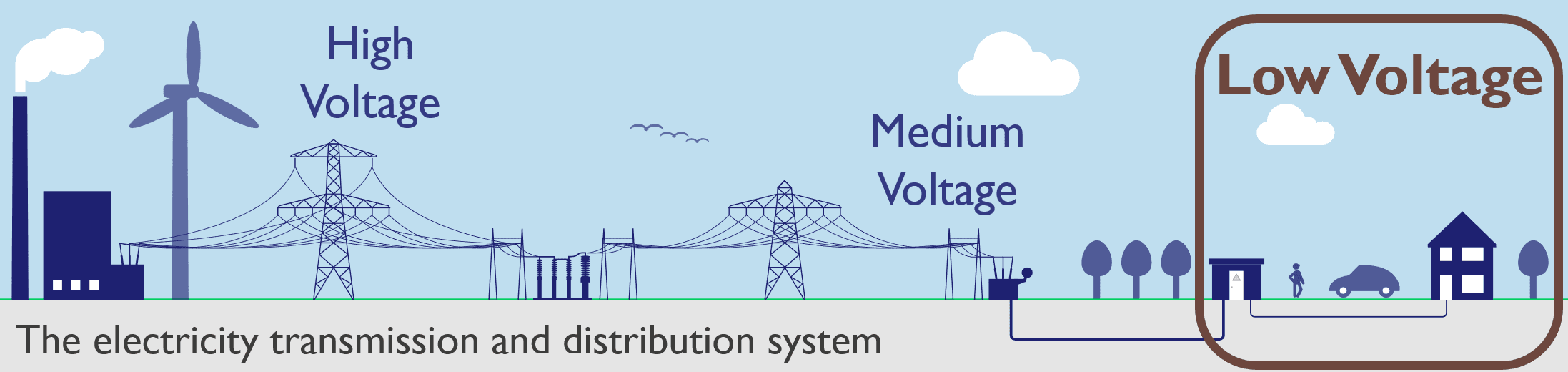
The Low Voltage (LV) distribution grid (the part of the electric grid to which the end consumers and prosumers are connected) is a critical infrastructure for our society and an important enabler for the energy transition in Flanders. Hence, we have to make sure that the LV grid does not jeopardize the transition to a sustainable energy future, due to limitations when dealing with a significant increase in electricity demand. The use of our distribution networks is changing rapidly due to, among other things, the growth of renewable energy production (solar panels) and the electrification of transport and heat sources (charging of electric and hybrid cars and heat pumps). In Flanders, the charging of electric cars and the use of household appliances for additional frequency reserves are a particular concern given that they lead to higher loads on the grid, an increased synchronicity, which in turn leads to higher peak loads.
The LV grid as we know it today, was built over the course of the last century using a “fit and forget” strategy: install (over dimensioned) cables with sufficient capacity to cover all demand peaks. However, with the massive rollout of technology linked to the energy transition, the required capacity when using present safety margins would lead to a very high investment cost. A business-as-usual approach can hence lead to the LV distribution grid becoming a financial and practical obstacle to the transition to a sustainable energy system. The alternative is the development of technology to use the installed capacity more optimally by operating our grids closer to their limit, and to technically support measures to mitigate the impact of the energy transition. Although the workings of electric grids are well understood, the specific challenge with the LV distribution grid is the limited, incomplete, or incorrect available data: the layout and electric properties of the grids are only partially known, and measurements are very limited and rarely real time. Also, the scale of the problem is vast: Flanders counts with 40k LV transformers, 240k LV feeders, and 3.5M connection points. By combining newly available grid data, e.g., from digital meters, with AI techniques, we aim to calculate the grid load in detail both in time and space to assist distribution grid operators in their infrastructural and operational decisions to make more optimal use of the existing grid capacity and to avoid massive investments in new cables.
Results
Members of our team obtained the third position in the IEEE-CIS Competition titled “Technical Challenge on energy prediction from smart meter data” with a ratio-based approach. The proposed method consisted of different steps applied sequentially: pre-processing, data augmentation and normalization, clustering, prediction based on ratios and finally ensemble learning and post processing. In another work, we introduced a new two-layer hybrid Neural Network architecture called “Decomposition-Residuals Deep Neural Network (DR-DNN)” that was successfully used for day-ahead electricity demand forecasting. This architecture consists of one decomposition layer in which the raw time series are decomposed into trend, seasonal and residual signals, and one Deep Neural Network (DNN) layer for modelling unknown nonlinear patterns.
We have developed and implemented an interactive ILP (Inductive Logic Programming) method for learning relational concepts, such as house-cable connections, from examples. We are currently working towards the application of this method to the GIS (Geographic Information System) dataset provided by Fluvius (the Flemish distribution grid operator), to better determine the house-cable connections of a city in Flanders.
We have clustered consumption user profiles using an active semi-supervised method, COBRAS. The method incorporated a new dissimilarity measure proposed exclusively for this use case, as well as a new time series representation for flexible supervision expert feedback. Finally, by applying K-medoids clustering on voltage time series from smart metering, we were able to validate grid topology data and derived which household is connected to what electrical phase
Basic Use Case Information
Period
2019-2023
Contact
Koen Vanthournout (VITO/Energyville)
Research Groups
KU Leuven – STADIUS, KU Leuven – DTAI and VITO/Energyville