
Improving MS Treatment
FAIR 1 Archive Notice
This page describes research activities and results from the FAIR 2019-2023 program period.
The content is retained for reference purposes and is no longer actively maintained. Information on this page, including research outputs, team members, contact details, collaborations and links, may be incomplete or outdated.
This use case has been succeeded by the Real-world evidence use case within the FAIR 2024-2028 program.
Use Case Description
Multiple Sclerosis (MS) is an incurable disease, but initiating the proper treatment as soon as possible can slow down progression. Currently, many people with MS miss their window of opportunity. OUR TARGET: speed-up identification of right treatment for the right patient at the right time.
Research from the Flanders AI Research Program used in this use case
When using high-dimensional RWD, key challenges currently obstruct us from reaching personalized insights. These challenges are:
-Real-world data (RWD) consists of different data types, is messy & heterogeneous
-Scaling-up high-dimensional RWD increases privacy risk
-Selecting the biomarkers of interest is complex
-Coping with high-dimensional trajectory data with different levels of missingness complicates building trustworthy prediction models
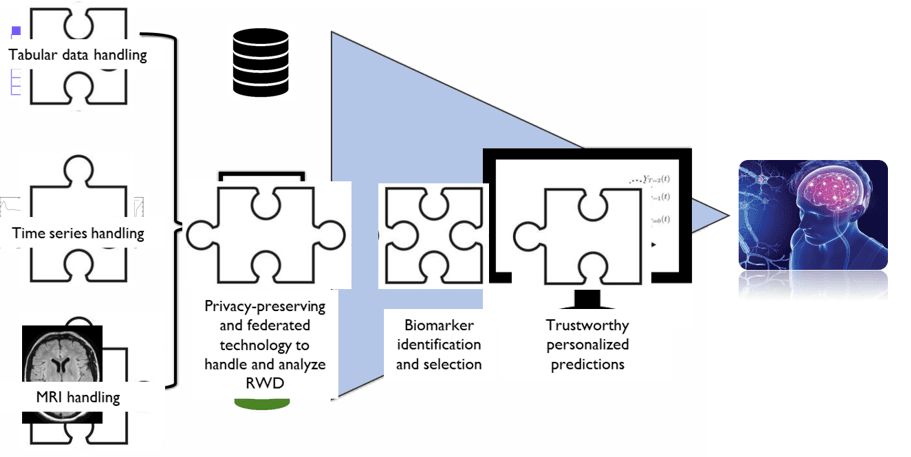
In this use case, we came up with solutions to tackle these challenges:
-Tabular data, time series, MRI handling
-Privacy-preserving and federated technology to handle and analyze RWD
-Biomarker identification and selection
-Trustworthy personalized predictions
To meet the challenges, we work on 4 different Proof of Concepts (POC):
POC1 (= federated architecture that was used in the COVID-19 in MS Global Data Sharing initiative, a project of the MS Data Alliance):
-Goal: To speed-up collaborative research projects of real-world MS data research
-Methods: federated learning analytics and automated data quality assessment and enhancement pipelines
POC2:
-Goal: To develop a decision support system to predict progression of MS
-Methods: AI algorithms that cope better with missingness of trajectory data (longitudinal data) and increase interpretability of results
POC3:
-Goal: Identify new biomarkers for disease progression
-Methods: using AI algorithm that cope better with and/or improve data quality of small high-dimensional trajectory real-world data with a specific focus on MRI and time series data
POC4:
-Goal: To speed-up the set-up of data infrastructures handling real-world data
-Methods: AI tools that speed-up data wrangling, data integration, data visualization and data sharing through federated learning technologies
List of demonstrable results:
-COVID-19 in MS global data sharing initiative
-Identification of new biomarkers in MRI and evoked potentials for MS
-AI tools to handle real-world MRI images (before and after images)
-Cope with bias in federated learning
List of uptake by external companies or organizations:
-Hospitals (e.g. Noorderhart, ZOL Genk) – AI tools for real-world data handling – speed-up data handling
-Icometrix – AI tools for real-world MRI images – improve performance compared to state-of-the-art
Basic Use Case Info
Period
2019-2023
Contact
Lotte Geys (lotte.geys@uhasselt.be)
Research Groups
Hasselt University, Research group in Biomedical Data Sciences (Prof: Liesbet M. Peeters) (link to website of the group)
KU Leuven, DTAI, STADIUS, ITEC
Ghent University, IDLab, KERMIT
Antwerpen University, VisionLab