
Real-World Evidence
Use Case Description
There is great promise in the use of Real-World Data (RWD) to generate so-called Real-World-Evidence (RWE). RWD is pragmatically defined as any data that is gathered within the context of standard of care. RWD is considered of increasing importance because it enables researchers to go beyond data gathered throughout traditional randomized clinical trials (RCTs) or carefully designed prospective research projects. Within the context of this Use Case, RWE is defined as any evidence and/or insights that is generated using RWD.
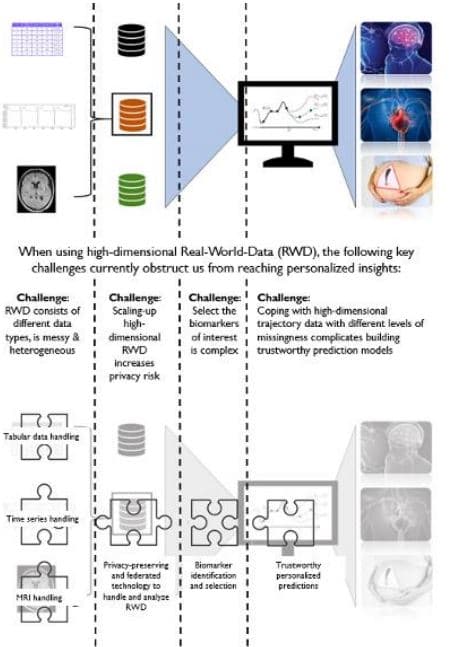
The figure below introduces the vision of our use case (= ultimate long-term goal). We strive towards personalized ‘real-world’ insights related to disease progression by scaling-up the use of ‘high-dimensional RWD’. With ‘high-dimensional RWD", we refer in the context of this Use Case to the combination of tabular data (e.g. Electronic Health Records or features extracted from other data sources), time series (e.g. evoked potentials, electrocardiogram or time series resulting from remote monitoring with devices) and images (e.g. magnetic resonance imaging).
We are convinced that robust end-to-end pipelines can be delivered that can be leveraged across different clinical finalities (e.g. multiple sclerosis (MS) and cardiovascular disorders) –since the key challenges that are currently obstructing us from reaching personalized real-world insights are the same across many (if not all) clinical finalities. In this use case, we focus on overcoming the following 4 key challenges.
RWD consists of different data types, is messy and heterogeneous
Scaling-up high-dimensional RWD is accompanied with severe privacy risks
Selecting the biomarkers of interest is complicated
Coping with high-dimensional trajectory data with different levels of missingness complicates
building trustworthy prediction models
We focus on developing 6 main AI ‘solutions’ (cfr ‘pieces of the puzzle’, see picture above) and integrate them into end-to-end pipelines that are robust to be leveraged across different clinical finalities. We focus on multiple key clinical disease areas such as MS and cardiovascular disorders.
Some numbers of interest:
Worldwide, there are more than 3 million people suffering from MS
Cardiovascular diseases are the leading cause of death globally. An estimated 17.9 million people died from cardiovascular disease in 2019, representing 32% of all global deaths.
Outputs & Resources
Publications
Simpson-Yap, S., de Brouwer, E., Kalincik, T., Rijke, N., Hillert, J., Walton, C., Edan, G., Moreau, Y., Spelman, T., Geys, L. and Parciak, T., 2020. First results of the COVID-19 in MS Global Data Sharing Initiative suggest anti-CD20 DMTs are associated with worse COVID-19 outcomes. Multiple Sclerosis Journal, 26(3_SUPPL), pp.48-49.
Peeters, L. M., Parciak, T., Walton, C., Geys, L., Moreau, Y., De Brouwer, E., ... & Rijke, N. (2020). COVID-19 in people with multiple sclerosis: a global data sharing initiative. Multiple Sclerosis Journal, 26(10), 1157-1162.
De Brouwer, E., Becker, T., Moreau, Y., Havrdova, E. K., Trojano, M., Eichau, S., ... & Peeters, L. (2020). Longitudinal modeling of MS patient trajectories improves predictions of disability progression. arXiv preprint arXiv:2011.04749.
Steve Simpson-Yap, Ashkan Pirmani, Tomas Kalincik, Edward De Brouwer, Lotte Geys, Tina Parciak, Anne Helme, Nick Rijke, Jan Hillert, Yves Moreau, Gilles Edan, Tim Spelman, Sifat Sharmin, Robert McBurney, Hollie Schmidt, Arnfin Bergmann, Stefan Braune, Alexander Stahmann, Amber Salter, Bruce Bebo, Anneke Van der Walt, Helmut Butzkueven, Serkan Ozakbas, Rana Karabudak, Raed Alroughani, Juan I Rojas, Ingrid Van Der Mei, Guilherme Sciascia do Olival, Melinda Magyari, Ricardo Alonso, Richard Nicholas, Anibal Chertcoff, Ana Zabalza, Georgina Arrambide, Nupur Nag, Annabel Descamps, Lars Costers, Ruth Dobson, Aleisha Miller, Paolo Rodriguez, Vesna Prchkovska, Giancarlo Comi, Liesbet Peeters - 2233 Updated results of the COVID-19 in MS global data sharing initiative: anti-CD20 DMTs deleterious for COVID-19 severity but interferons not protective among people with MS: BMJ Neurology Open 2024;4:.
Simpson-Yap, S., Pirmani, A., De Brouwer, E., Peeters, L. M., Geys, L., Parciak, T., ... & Kalincik, T. (2022). Severity of COVID19 infection among patients with multiple sclerosis treated with interferon-β. Multiple Sclerosis and Related Disorders, 66, 104072.
Simpson-Yap, S., De Brouwer, E., Kalincik, T., Rijke, N., Hillert, J. A., Walton, C., ... & Peeters, L. (2021). Associations of disease-modifying therapies with COVID-19 severity in multiple sclerosis. Neurology, 97(19), e1870-e1885.
Pirmani, A., De Brouwer, E., Geys, L., Parciak, T., Moreau, Y., & Peeters, L. M. (2023). The Journey of Data Within a Global Data Sharing Initiative: A Federated 3-Layer Data Analysis Pipeline to Scale Up Multiple Sclerosis Research. JMIR Medical Informatics, 11(1), e48030.
Khan, H., Geys, L., Baneke, P., Comi, G., & Peeters, L. M. (2024). Patient level dataset to study the effect of COVID-19 in people with Multiple Sclerosis. Scientific data, 11(1), 149.
De Brouwer, E., Becker, T., Werthen-Brabants, L., Dewulf, P., Iliadis, D., Dekeyser, C., ... & Peeters, L. (2024). Machine-learning-based prediction of disability progression in multiple sclerosis: An observational, international, multi-center study. PLOS digital health, 3(7), e0000533.
Pirmani, A., De Brouwer, E., Oldenhof, M., Passemiers, A., Van Wijmeersch, B., Butzkueven, H., Horakova, D., Ozakbas, S., Patti, F., Madueno, S.E. and Duquette, P., 2024. Transforming Multiple Sclerosis Research: Advancing Disability Progression Insights through Practical and Precise Federated Learning using Real-World Data.
Pirmani, A., Oldenhof, M., Peeters, L.M., De Brouwer, E. and Moreau, Y., 2024. Accessible ecosystem for clinical research (federated learning for everyone): development and usability study. JMIR Formative Research, 8, p.e55496.
Pirmani, A., Moreau, Y. and Peeters, L.M., 2024. Unlocking the Power of Real-World Data: A Framework for Sustainable Healthcare. Studies in Health Technology and Informatics, 316, pp.1582-1583.
Giraldo, D.L., Khan, H., Pineda, G., Liang, Z., Lozano-Castillo, A., Van Wijmeersch, B., Woodruff, H.C., Lambin, P., Romero, E., Peeters, L.M. and Sijbers, J., 2024. Perceptual super-resolution in multiple sclerosis MRI. Frontiers in Neuroscience, 18, p.1473132.
Parciak, M., Vandevoort, B., Neven, F., Peeters, L.M. and Vansummeren, S., 2024. Schema matching with large language models: an experimental study. arXiv preprint arXiv:2407.11852.
Pirmani, A., De Brouwer, E., Arany, Á., Oldenhof, M., Passemiers, A., Faes, A., Kalincik, T., Ozakbas, S., Gouider, R., Willekens, B. and Horakova, D., 2025. Personalized federated learning for predicting disability progression in multiple sclerosis using real-world routine clinical data. NPJ digital medicine, 8(1), p.478.
Faes A. Primani A., Moreau Y, Peeters, L.M., 2025. Applying Federated Learning to Block-Term Tensor Regression for Heart Disease Prediction. FLTA2025
PhD dissertations
Lorin Werthen-Brabants “Quantifying Uncertainty and Improving Reliability of Time-Series Based Deep Learning Models”, 2023
Edward de Brouwer “Machine learning modeling of time-dependent patient trajectories”, 2023
Ashkan Pirmani “Federated artificial intelligence for multiple sclerosis patient trajectories in a real-world setting”, 2024
Hamza Khan “New kids on the block: Improving the care of people with multiple sclerosis by introducing “Radiomics” and “Epomics””, 2025
Marcel Parciak “Accelerating Open Data Integration of Real-World Health Data Silos”, 2025
Collaborative projects
Already existing:
MS DataConnect,
Covid19 in MS Global Data Sharing Initiative,
MS Data Alliance,
BELTRIMS
New since kick-off new roadmap:
BRANDO,
FL4PHM,
FL4Cardio
Related projects and initiatives outside the Use Case
OHDSI Belgium,
Medemotion,
Health Campus Limburg,
ELIXIR BE connection,
one million genome biobank,
data4PHM
Multi-stakeholder partners
Hospitals: e.g. Noorderhart, Ziekenhuis Oost-Limburg, …
Industry: Janssen, Novartis, …
Regulators: Health Data Agency, EWI, …
…
Outreach
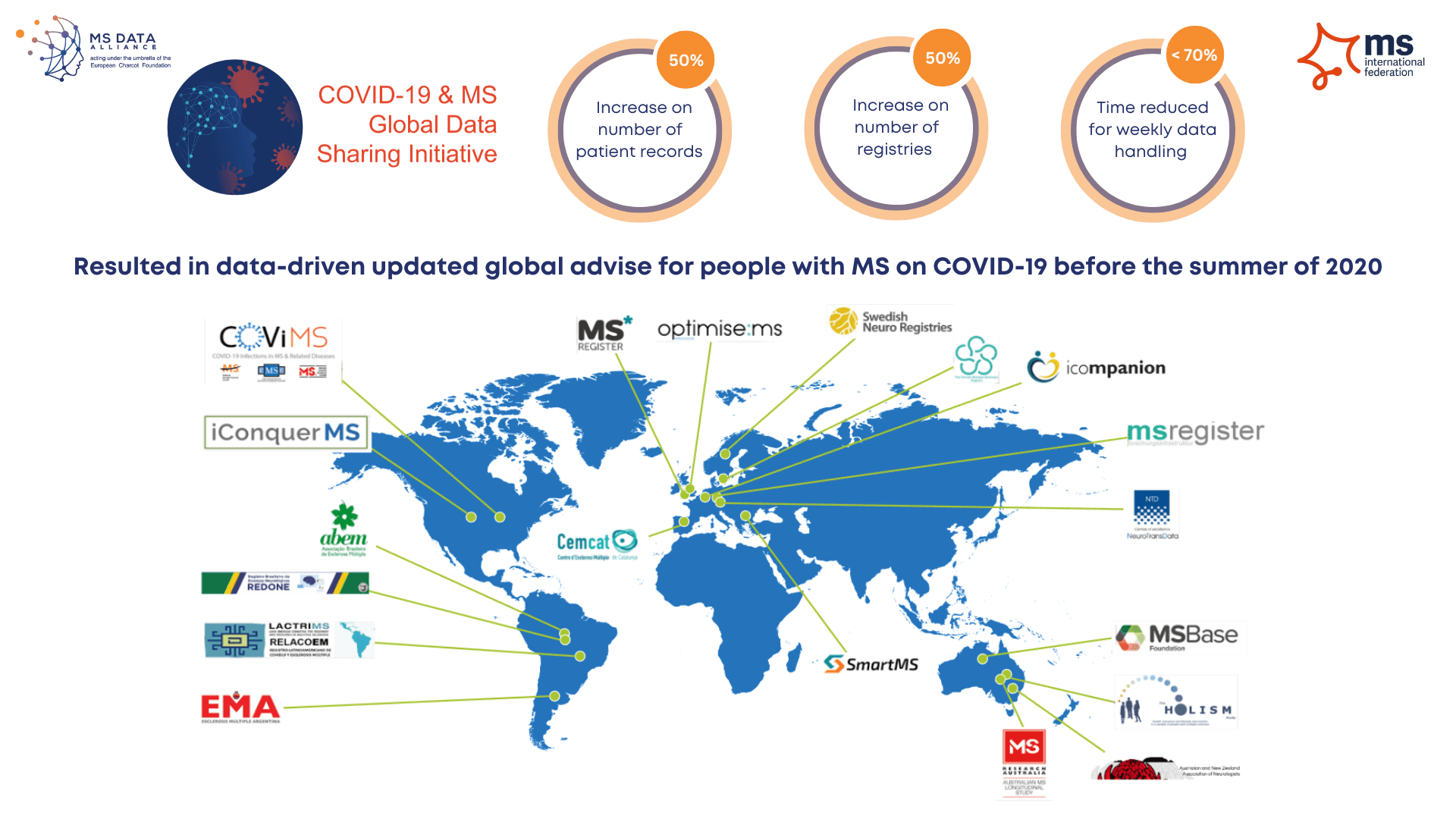
Used to showcase the successful collaborations between Belgium and Australia in the field of secondary re-use of health data during the Royal Economic Mission in Melbourne
(18th October – 28th of October 2023)
Uptake / Proof of Concept
Name of the POC | POC leader | Clinical challenge(s) | Technical challenge(s) | Datasets to be used |
|---|---|---|---|---|
Risk Progression - Cardiovascular Diseases | Axel Faes | Prediction progression cardiovascular disorders | Time series and tabular data handling | Cardiovascular data ZOL Genk |
Sandbox of use cases | Liesbet Peeters | Different clinical challenges beyond MS and cardio | No specific technical challenge | To be determined (key outcome of the POC) |
BELTRIMS - Automated Schema Mapping | Stijn Van Summeren | No specific clinical target | Heterogeneity of tabular data | BELTRIMS switchboxes |
Automated Anomaly Detection | Luc De Raedt | No specific clinical target | Heterogeneity of tabular data | MSBase dataset |
MRI Harmonization Strategies | Jan Sijbers | Prediction progression multiple sclerosis | Heterogeneity of MRI data | MS-Radiomics-Epomics |
High-Dimensional Visualization of MS trajectories | Yvan Saeys | Identify biomarkers for MS progression | Biomarker identification and selection | Epomics Open Source MS-Flow Cytometry MS-Radiomics-Epomics |
Federated Learning - Multiple Sclerosis (bias IID vs non-IID) | Yves Moreau | Prediction progression multiple sclerosis | Privacy-preserving and federated technology | MS-Radiomics-Epomics MSBase dataset |
What's next
Phase 1: Extending FAIR's real-world evidence expertise to new clinical domains
Goal
Develop an end-to-end pipeline for cardiovascular diseases (POC1) and establish a sandbox for additional use cases (POC2), leveraging methodologies and experience from the Multiple Sclerosis use case developed during FAIR 2019-2023. The aim is to address similar challenges in cardiovascular diseases, new multiple sclerosis datasets, and other clinical application domains.
Methodology
Apply and adapt the methodologies developed within the FAIR 2019-2023 Multiple Sclerosis use case as a foundation for new clinical domains and datasets.
Results
Identification and documentation of first lessons learned from transferring FAIR's real-world evidence methodologies towards new clinical applications.
Phase 2: Developing and benchmarking new AI solutions
Goal
Develop new and improved AI solutions for real-world evidence generation, using FAIR Multiple Sclerosis tasks as a benchmark.
Methodology
Parallel development and benchmarking of the following AI solutions using FAIR Multiple Sclerosis tasks:
Automated schema mapping for heterogeneous tabular healthcare data (POC3)
Automated anomaly detection in real-world data (POC4)
MRI harmonisation strategies (POC5)
Privacy-preserving learning across multiple organisations (POC6)
Biomarker identification and selection through visualisation of high-dimensional longitudinal datasets (POC7)
Coping with IID versus non-IID bias in federated learning (POC8)
Results
New and improved AI solutions for:
Tabular data handling through automated schema mapping and anomaly detection
MRI harmonisation
Privacy-preserving multi-party learning
Biomarker identification and selection
Federated learning under heterogeneous data distributions
In addition, an improved end-to-end pipeline will be developed for cardiovascular diseases (POC9) and other clinical use cases (POC10).
Phase 3: Evaluating and validating impact
Goal
Re-evaluate the impact of the revised end-to-end pipelines and newly developed AI solutions.
Methodology
Use the outcomes and performance of POC1 and POC2 as benchmarks for comparison against the revised solutions.
Results
Validation of revised AI solutions and end-to-end pipelines
Quantification of improvements and added value
Identification and documentation of lessons learned for future real-world evidence applications
Team & Contact
Contact
Use Case Lead - Liesbet M. Peeters: e-mail
Scientific Coordinator - Axel Faes: e-mail
Use Case Lead(s)
Liesbet M. Peeters, Research Group of Biomedical Data Sciences, UHasselt
Principal Investigators / AI Expert Leads
Yves Moreau, KU Leuven; Stijn Van Summeren, UHasselt; Frank Neven, UHasselt; Jan Sijbers, imec / UAntwerpen; Celine Vens; Dirk Deschrijver, imec / UGent; Yvan Saeys, VIB
Postdoctoral Researchers
Axel Faes, UHasselt; Ashkan Pirmani, KU Leuven / UHasselt; Lorin Werthen-Brabants, imec / UGent
PhD Researchers
Marcel Parciak, UHasselt; Diana Girado; Jana Osstyn; Robbe Dhondt; Luca Leomazzi
Research Groups
Research Groups | Researcher name | Specific task / comments |
|---|---|---|
Liesbet M. Peeters (LMP - UHasselt) | Axel Faes (postdoc) and LMP team | Overall coordination, Lead on study design of new use cases, overcome ethical and legal challenges |
Stijn Van Summeren & Frank Neven (UHasselt) | Marcel Parciak (Joined Phd student with LMP) |
AI solutions for tabular data handling |
Yves Moreau (KULeuven) | Ashkan Pirmani (Joined postdoc with LMP) |
AI solutions for privacy-preserving and federated technologies |
Jan Sijbers (Imec, UAntwerpen) | Diana Girado, Jana Osstyn |
AI solutions for MRI data handling |
Celine Vens | Robbe Dhondt |
AI solutions for trustworthy personalized predictions |
Dirk Deschrijver (Imec-UGent) | Lorin Werthen-Brabants (postdoc) | AI solutions for trustworthy personalized predictions |
Yvan Saeys (VIB) | Luca Leomazzi | AI solutions for data visualizations |