
Automated detection of Epileptic Seizures
FAIR 1 Archive Notice
This page describes research activities and results from the FAIR 2019-2023 program period.
The content is retained for reference purposes and is no longer actively maintained. Information on this page, including research outputs, team members, contact details, collaborations and links, may be incomplete or outdated.
This use case has been succeeded by the Monitoring at home use case within the FAIR 2024-2028 program.
Use Case Description
Goal of the use case
Epilepsy is a neurological disease that affects around 65 million people worldwide. Despite the different currently available treatments, still 35% of the patients continue to have seizures for the rest of their lives. The quality of life (QoL) of these patients and their relatives is strongly influenced by the unexpected behavior of epileptic seizures. One option to improve their QoL is to use an automated seizure warning system, which automatically detects ongoing seizures and alarms the patient’s relatives. This way, both patient and relatives feel reassured knowing someone will help them when a seizure occurs in their everyday environment.
Another option to improve their QoL is to optimize the treatment itself. Currently, treatment evaluation relies on manual seizure diaries maintained by the patient itself, which have shown to have an accuracy under 50%. An objective and automated seizure diary could lead to better patient treatment due to more reliable information for the clinician.
Both applications rely on the automated detection of epileptic seizures. Literature however (see [6] and references herein) showed that there are multiple challenges in this field, which currently lead to a too low accuracy of these algorithms, including the wide variety of seizure types, the patient-dependency of epileptic changes, the lack of accurately annotated data, poor data quality and suboptimal multimodal combination. These challenges are however currently insufficiently addressed in literature, whereas solving these challenges could lead to wide usage of these monitoring applications.
Different stakeholders can benefit from improved monitoring of epilepsy patients. The QoL of epilepsy patients and their relatives can be strongly improved by either feeling more secure at home or a better treatment selection (decreased seizure frequency). The neurologists get access to more accurate and objective information from the ongoing treatments through the automated seizure diaries, which allows to select a better treatment selection.
Such an automated monitoring system allows the pharmacy industry to select more efficiently the right type of patients for their drug trials, which could lead to a large cost saving. The developed methods can also be reused for other health applications by the medical device industry. Insurance companies can also see a decrease in expenses as a seizure warning system decreases the risk of injuries or post-ictal complications.
Research
Multimodal classification of seizures
Automated feature extraction
Personalized seizure detection algorithms
Clinical decision support

Results
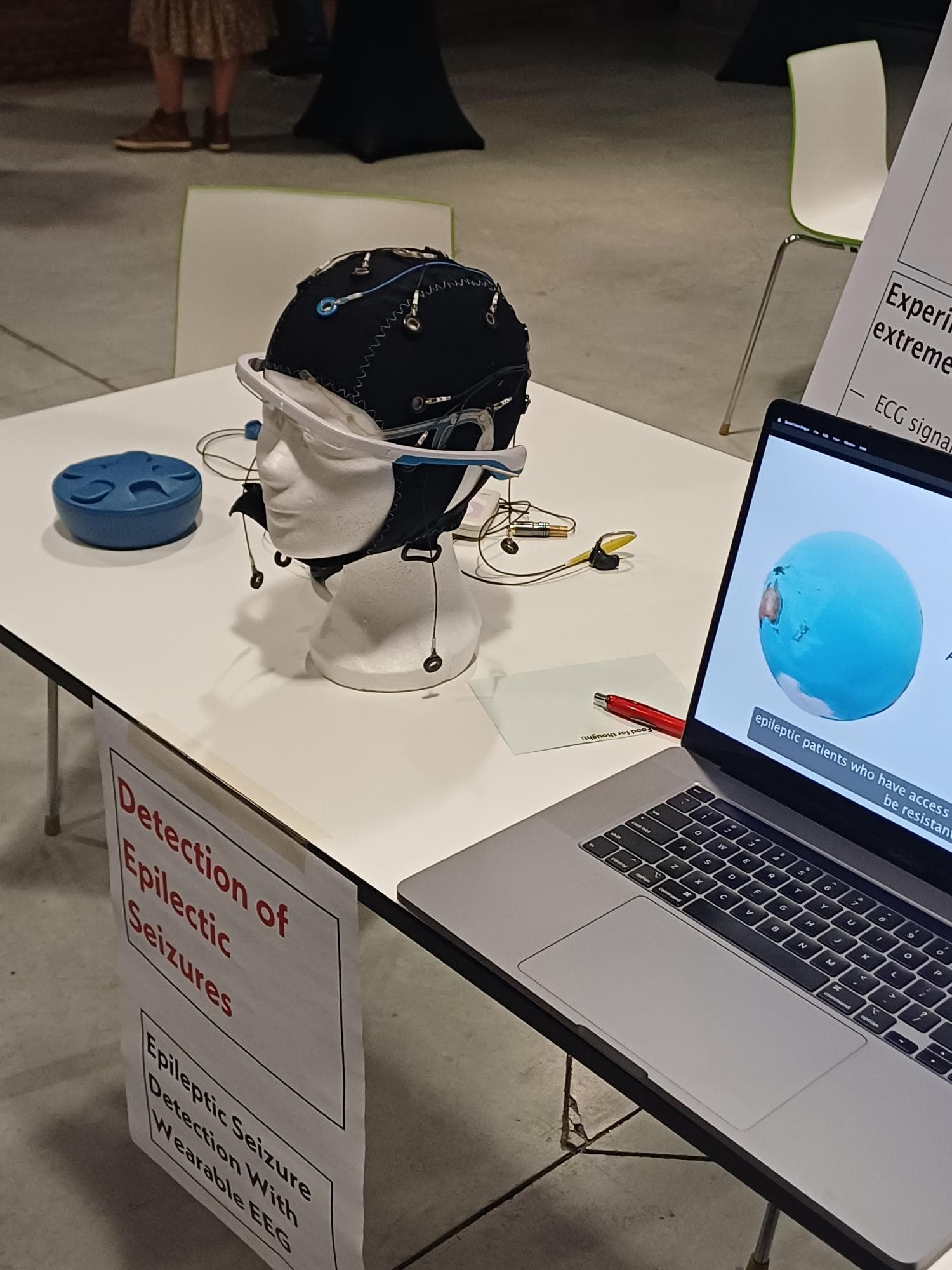
The epilepsy UC aimed into developing an improved AI framework for automated epilepsy monitoring based on data recorded with wearable sensors. Major challenges include data quality of the recorded multimodal signals, inability to obtain large amounts of accurate labels, and the variability of seizure patterns present across patients.
Several AI concepts have been designed and optimized to address those challenges.
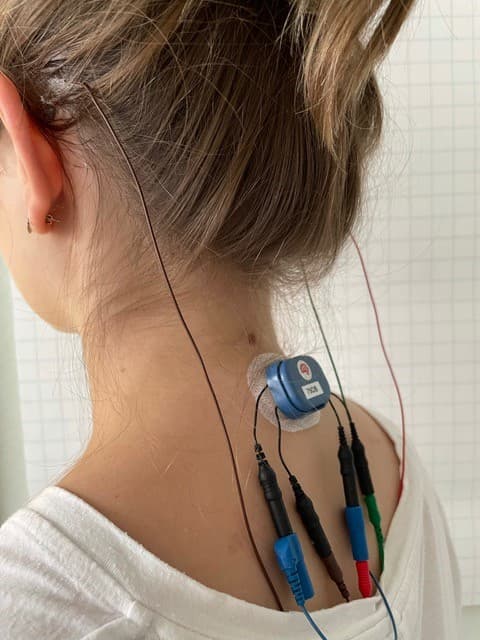
The latest model that we created is a general event-based detector for detecting events in time series, that has been successfully validated for both detecting artifacts and seizures in EEG [1]. Second, we have demonstrated that automatically generated features allow to detect seizures almost as good as expert-crafted features, but fusing of both types of features gives an optimal result [2]. One of the main contributions of this use case is the analysis of the impact of integrating information from multimodal signals [3-5]. This allows mainly to reduce the number of false alarms in seizure detection dramatically, either by having different sensitvity to noise and artifacts in the various modalities, or by explicitly crafting AI routines that distinguish artefacts from noise.
We have also focused on the automatic optimization of the labels provided by the experts by employing a self-confidence-based metho [6]. In the same research direction, by deploying a learning strategy optimizing for high detection sensitivity and quantifying detection (un)certainty, the review time of data from absence patients by the neurologist can be reduced from 2 hours to five minutes per patient [7]. Moreover, we have demonstrated that integration of multiple wearable modalities (EEG and ECG) can lead to improved detection sensitivity (+ 11%) [8]. Overall, by combining all those contributions, a significant improvement has been made in automated algorithms for seizure detection compared to the past years.
The overall improvement of seizure detection was exhibited in multiple publications [9-10], of which the latest won also the BEST PAPER AWARD in IEEE SPMB 2020. Furthermore, a group of researchers that participated in FAIR and our UC won the first place in Neureka 2020 Challenge, a world-wide challenge which employed the biggest available dataset in the world in a seizure detection task.
Outreach
Seizure Detection Grand Challenge ICASSP 2023
AI for Time Series (webinar). "Seizure Detection with Wearable Devices and AI"
Highway Session. "Innovative AI Solutions for Personalized Healthcare"
Publications
[1] Seeuws, N., De Vos, M. and Bertrand, A. (2023). Avoiding Post-Processing with Event-Based Detection in Biomedical Signals. arXiv:2209.11007v2 (under review)
[2]De Brabandere, A., Chatzichristos, C., Van Paesschen, W., De Vos, M. and Davis, J. (2024). Detecting Epileptic Seizures Using Hand-Crafted and Automatically Constructed EEG Features. IEEE TRANSACTIONS ON BIOMEDICAL ENGINEERING, 71 (1), 318-325. doi: 10.1109/TBME.2023.3299821
[3] Bhagubai, M., Vandecasteele, K., Swinnen, L., Macea, J., Chatzichristos, C., De Vos, M., Van Paesschen, W. (2023). The Power of ECG in Semi-Automated Seizure Detection in Addition to Two-Channel behind-the-Ear EEG. BIOENGINEERING-BASEL, 10 (4), Art.No. ARTN 491. doi: 10.3390/bioengineering10040491
[4] Swinnen, L., Chatzichristos, C., Bhagubai, M., Broux, V., Zabler, N., Duempelmann, M., Schulze-Bonhage, A., De Vos, M., Van Paesschen, W. with Swinnen, L. (corresp. author) (2023). Home recording of 3-Hz spike-wave discharges in adults with absence epilepsy using the wearable Sensor Dot. EPILEPSIA. doi: 10.1111/epi.17839
[5] Chatzichristos, C., Swinnen, L., Macea, J., Bhagubai, M., Van Paesschen, W., De Vos, M. (2022). Multimodal detection of typical absence seizures in home environment with wearable electrodes. Frontiers in Signal Processing, 2, Art.No. 1014700. doi: 10.3389/Frsip.2022.1014700 via repository
[6] Zhang, J., Chatzichristos, C., Vandecasteele, K., Swinnen, L., Broux, V., Cleeren, E., Van Paesschen, W., De Vos, M. (2022). Automatic annotation correction for wearable EEG based epileptic seizure detection. Journal Of Neural Engineering, 19, Art.No. 016038. doi: 10.1088/1741-2552/ac54c1
[7] Becker, T., Vandecasteele, K., Chatzichristos, C., Van Paesschen, W., Valkenborg, D., Van Huffel, S., De Vos, M. (2021). Classification with a Deferral Option and Low-Trust Filteringfor Automated Seizure Detection. Sensors, 21 (4), Art.No. 1046. doi: 10.3390/s21041046
[8] Vandecasteele, K., De Cooman, T., Chatzichristos, C., Cleeren, E., Swinnen, L., Ortiz, J.M., Van Huffel, S., Duempelmann, M., Schulze-Bonhage, A., De Vos, M., Van Paesschen, W., Hunyadi, B. (2021). The power of ECG in multimodal patient-specific seizure monitoring: Added value to an EEG-based detector using limited channels. EPILEPSIA, 62 (10), 2333-2343. doi: 10.1111/epi.16990
[9] Swinnen, L., Chatzichristos, C., Jansen, K., Lagae, L., Depondt, C., Seynaeve, L., Vancaester, E., Van Dycke, A., Macea, J., Vandecasteele, K., Broux, V., De Vos, M., Van Paesschen, W. (2021). Accurate detection of typical absence seizures in adults and children using a two-channel electroencephalographic wearable behind the ears. Epilepsia. doi: 10.1111/epi.17061
[10] Chatzichristos, C., Dan, J., Narayanan, M., Seeuws, N., Vandecasteele, K., De Vos, M., Bertrand, A., Van Huffel, S. (2020). Epileptic Seizure Detection in EEG via Fusion of Multi-View Attention-Gated U-net Deep Neural Networks. In: IEEE SPMB. Presented at the The 2020 IEEE Signal Processing in Medicine and Biology Symposium (IEEE SPMB), Pennsylvania, USA (online), 05 Dec 2020-05 Dec 2020. BEST PAPER AWARD
Read our story!
External experts and User Groups
External experts
Prof. Wim Van Paesschen (neurologist - epileptologist)
Basic Use Case Info
Period
2019-2023
Contact
Maarten De Vos, maarten.devos@kuleuven.be
Christos Chatzichristos, christos.chatzichristos@kuleuven.be
Research Groups
Stadius, ESAT, KULeuven
IDLab, KERMIT, UGent
CENSTAT UHasselt
What's next?
Wearable physiological monitoring @ home