
Monitoring@Home
Use Case Description
Wearable patient monitoring at home opens doors by providing an additional channel for high-quality care. There are a variety of benefits both for clinicians and for patients:
Availability of big data. Wearable devices continuously capture data from the patients' vital signs. This makes it much easier for clinicians to spot trends and make more informed decisions. Providers no longer have to rely only on data from in-person visits or self-assessments, and these additional insights give a more holistic view of the individual’s condition and how it is progressing.
Engagement of patients. Wearable sensors for remote health monitoring empower individuals to participate more in their own care, increase accountability, and allow them to see progress in real time.
Early interventions. The need for a possible intervention or alteration of medication is spotted in time by automating the analysis of vital signals. This provides the opportunity to reach out and intervene before the situation becomes serious enough to warrant a hospital visit.
The current use case is an extension of the Epilepsy use case in FAIR 1, in particular by focusing on (challenges related to) data acquired outside traditional hospital settings, extending the amount of data both in volume and in the number of neurological disorders to be studied. There is still an initial focus on Epilepsy and Sleep disorders.
Epilepsy
Epilepsy is a neurological disease that affects around 65 million people worldwide. Despite the different currently available treatments, still 35% of patients continue to have seizures for the rest of their lives. The quality of life (QoL) of these patients and their relatives is strongly influenced by the unexpected behavior of epileptic seizures.
One option to improve their QoL is to use an automated seizure warning system, which automatically detects ongoing seizures and alarms the patient’s relatives. This way, both patient and relatives feel reassured knowing someone will help them when a seizure occurs in their everyday environment.
Another option to improve their QoL is to optimize the treatment itself. Currently, treatment evaluation relies on manual seizure diaries maintained by the patient itself, which have shown to have an accuracy under 50%. An objective and automated seizure diary could lead to better patient treatment due to more reliable information for the clinician.
Both applications rely on the automated detection of epileptic seizures. Literature, however (DeCooman 2018), showed that there are multiple challenges in this field, which currently lead to too low accuracy of these algorithms, including the wide variety of seizure types, the patient-dependency of epileptic changes, the lack of accurately annotated data, poor data quality and suboptimal multimodal combination. These challenges are currently insufficiently addressed in literature, whereas solving them could lead to wide usage of these monitoring applications.
Sleep disorders
Sleep disorders include sleep apnea, parasomnias and hypersomnia. Various studies worldwide have shown the prevalence of insomnia in 10%–30% of the population, some even as high as 50%–60%. Moreover, sleep disorders are very common comorbidities to many disorders, whereby the sleep disturbance aggravates the disease, but the disease can also lead to poor sleep. Overnight polysomnography (PSG), including brain monitoring using electroencephalography (EEG), is a central component of the diagnostic evaluation for sleep disorders. While PSG is conventionally performed by trained technologists, the recent rise of powerful neural network learning algorithms combined with large physiological datasets offers the possibility of automation, potentially making expert-level sleep analysis more widely available. Automating sleep staging is vital to scale up sleep assessment and diagnosis to serve millions experiencing sleep deprivation and disorders and enable longitudinal sleep monitoring in home environments. Learning from raw polysomnography signals and their derived time-frequency image representations for healthy volunteers has been prevalent. However, making algorithms reliable for patients with various disorders is challenging, and obtaining similar information from wearable devices as from lab-based recordings needs further research.
Parkinson’s disease and Freezing of Gait
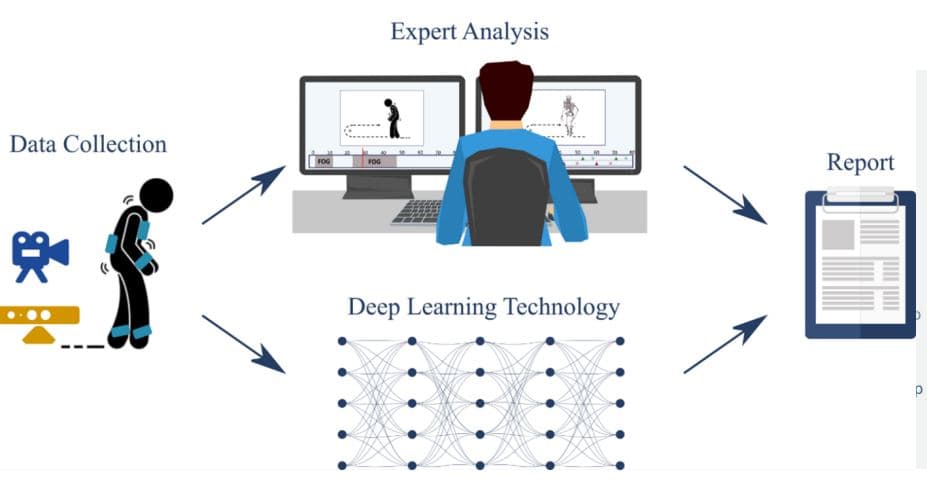
Freezing of gait (FOG), whereby patients suddenly lose the ability to walk, is quite possibly the most debilitating symptom of Parkinson’s disease (PD). PD is the second most common neurodegenerative disorder, affecting around 2% of older people (>60 years). Alarmingly, PD is one of the fastest growing neurological disorders with a prevalence that doubles every 20–30 years. Due to ageing and environmental factors, 4.3 million people will be living with PD by 2040 in the EU alone. Most PD patients will develop FOG in the course of the disease (70% after 5–10 years), a turning point called ‘FOG conversion’. Once this milestone is reached, patients experience more anxiety, have a lower quality of life and are at a much higher risk of falls. Current treatments are unable to slow down PD and offer only partial relief for FOG. The most important limitation to advance novel treatments is the difficulty to measure FOG. Traditional in-clinic or self-reported FOG measures can be subject to recall bias, Hawthorne effects and substantial training requirements. Moreover, a single observation may not be reliable, especially as motor impairments in PD fluctuate over acute periods of time. Objective FOG assessment thus calls for FOG outcomes that sensitively capture changes in functional mobility more frequently. As it is not feasible to increase patient visits to the clinic, this pertains to establishing a continuous, at-home version of a clinical FOG assessment. Maturity of deep learning (DL) technology allowed us to establish novel and objective FOG outcomes during well-defined in-lab tests. Unlike gait collected during constrained in-lab measurements, however, free-living captures gait in a wide framework of contexts, each involving different neuromotor strategies. Recent evidence suggests that DL architectures must incorporate multimodal data to make them more robust, accurate and capable of characterizing FOG during free-living gait. PD is, however, characterized by substantial inter-subject variability and further basic research is required to establish reliable multimodal fusion algorithms that require minimal adaptation to a particular subject.
Results, Highlights & Research Outputs
CoRe-Sleep: Robust multimodal sleep staging
CoRe-Sleep introduces a model designed for automated sleep staging using physiological recordings like EEG and EOG. The model leverages a coordinated representations multimodal fusion approach, enhanced with unimodal and contrastive losses, making it state-of-the-art in the largest sleep staging classification dataset. This architecture enables the model to handle missing or noisy data effectively. Additionally, it can train on incomplete datasets, allowing it to use patient recordings with partial data. The paper aims to bridge the gap between existing models and the practical application of automated sleep analysis in clinical settings.
Publication
[1] K. Kontras, C. Chatzichristos, H. Phan, J. Suykens and M. De Vos, "CoRe-Sleep: A Multimodal Fusion Framework for Time Series Robust to Imperfect Modalities," in IEEE Transactions on Neural Systems and Rehabilitation Engineering, vol. 32, pp. 840-849, 2024
U-PASS: Uncertainty-guided automated sleep staging
As machine learning becomes more prevalent in healthcare, ensuring safety and reliability is critical. This study introduces U-PASS, a human-centered machine learning pipeline designed for clinical applications, which integrates uncertainty estimation to improve reliability. U-PASS enhances performance by communicating uncertainty to clinical experts and incorporating their feedback, optimizing the training dataset, and deferring uncertain cases to experts. Applied to sleep staging in elderly sleep apnea patients, U-PASS increases accuracy from 75% to 85%, demonstrating its potential to enhance clinical decision-making.
Publication
[2] Elisabeth R.M. Heremans, Nabeel Seedat, Bertien Buyse, Dries Testelmans, Mihaela van der Schaar, Maarten De Vos, “U-PASS: An uncertainty-guided deep learning pipeline for automated sleep staging,” Computers in Biology and Medicine, Volume 171, 2024.
Wearable EEG seizure detection
Ambulatory patient monitoring has been made possible due to the surge of wearable medical devices. In this work, we present various strategies for automatically detecting seizures in epilepsy patients based on data measured with a wearable EEG device (the Sensor Dot). We compare different methodologies, ranging from feature-based machine learning methods to deep learning methods. Furthermore, we evaluate data-centric strategies with the objective of improving the quality of the training data for improving the performance of specific models. The work presented was part of an international seizure detection challenge launched to promote the development of ML methods for wearable signal classification.
Publication
[3] M. Bhagubai, L. Swinnen, E. Cleeren, W. Van Paesschen, M. De Vos and C. Chatzichristos, "Towards Automated Seizure Detection With Wearable EEG – Grand Challenge," in IEEE Open Journal of Signal Processing, vol. 5, pp. 717-724, 2024
Robust tonic-clonic seizure detection
Tonic-clonic seizures (TCSs) significantly increase the risk of sudden unexpected death in epilepsy (SUDEP). While previous research highlights the potential of multimodal wearable seizure detection systems for accurately detecting TCSs, these systems are more susceptible to sensor malfunctions. This paper proposes a cyclic transformer approach that uses circular modal translations to learn robust representations for TCS detection. It is trained on paired multimodal data but operates with only the source modality during deployment, ensuring robustness against missing information in the target modality.
Publication
[4] Zhang, J., Swinnen, L., Chatzichristos, C., Van Paesschen, W. and De Vos, M., 2024. Learning Robust Representations of Tonic-Clonic Seizures With Cyclic Transformer. IEEE journal of biomedical and health informatics, 28(6), pp.3721-3731
Freezing of gait manifestation detection
Freezing of gait (FOG) is a highly disabling episodic symptom of Parkinson’s Disease (PD) that can manifest in various ways, such as trembling in place or complete akinesia. This study aimed to analyze the effectiveness of deep learning (DL) models trained on inertial measurement unit data to classify these different manifestations of FOG. We adapted and compared four state-of-the-art FOG detection algorithms and explored the benefits of incorporating a refinement model to address oversegmentation errors. The model's performance in distinguishing between trembling, akinesia, and other forms of movement cessation, such as stopping and sitting, was evaluated against expert video annotations. This study is the first to demonstrate that DL can accurately assess different types of FOG manifestations, underscoring the need for further investigation in larger and more diverse verification cohorts.
Publication
[5] P.-K. Yang, B. Filtjens, P. Ginis, M. Goris, A. Nieuwboer, M. Gilat, P. Slaets, and B. Vanrumste, "Automatic Detection and Assessment of Freezing of Gait Manifestations," in IEEE Transactions on Neural Systems and Rehabilitation Engineering, vol. 32, pp. 2699-2708, 2024.
Freezing of gait assessment with IMUs and deep learning
Freezing of gait (FOG) is a disabling episodic symptom of Parkinson’s Disease (PD) that typically relies on time-consuming visual inspections of camera footage for assessment. Previous studies have suggested portable and automated solutions for annotating FOG; however, challenges arise due to gait variability caused by medication effects and different FOG-provoking tasks. This study aimed to evaluate an automated FOG assessment model using deep learning (DL) based on inertial measurement units (IMUs) to determine its ability to distinguish FOG from everyday movements, such as volitional stops. The findings indicate that DL models trained on IMU signals can accurately assess FOG across various medication states and FOG-provoking tasks. Additionally, the model showed a moderately strong agreement with expert annotations regarding FOG severity, but this was only achieved when stopping was included in the training data. This study paves the way for future research on automated FOG assessment in daily life.
Publication
[6] P.-K. Yang, B. Filtjens, P. Ginis, M. Goris, A. Nieuwboer, M. Gilat, P. Slaets, and B. Vanrumste, “Freezing of gait assessment with inertial measurement units and deep learning: effect of tasks, medication states, and stops,” Journal of NeuroEngineering and Rehabilitation, vol. 21, no. 1, p. 24, 2024.
Otago Exercise Program recognition
To improve the accuracy and simplify the design of traditional models for recognizing Otago Exercise Program (OEP), we developed a deep learning model based on micro labels. In the first stage, the model recognized each cycle of the exercises (micro labels). The following stages recognized the full range of the exercises (macro labels). The four target exercises could be recognized with f1-scores over 0.85, outperforming other state-of-the-art models. This architecture proposes a new scope for activity recognition, especially for OEP monitoring.
Publication
[7] M. Shang, L. Dedeyne, J. Dupont, L. Vercauteren, N. Amini, L. Lapauw, E. Gielen, S. Verschueren, C. Varon, W. De Raedt, and B. Vanrumste, “Ds-ms-tcn: Otago exercises recognition with a dual-scale multi-stage temporal convolutional network,” IEEE Journal of Biomedical and Health Informatics, pp. 1–13, 2024
Otago Exercise Program monitoring
Otago Exercise Program (OEP) is a rehabilitation program that could improve strength and balance for older adults. In this study, we developed a system to monitor OEP based on a single waist-mounted wearable IMU. Using a hierarchical machine learning model for classification, we achieved two tasks regarding OEP monitoring: the first stage recognized general OEP and daily activities with f1-scores over 0.95, and the second stage recognized some OEP sub-classes with f1-scores over 0.8. This is the first study proving the feasibility of such a user-friendly system for OEP monitoring.
Publication
[8] M. Shang, L. Dedeyne, J. Dupont, L. Vercauteren, N. Amini, L. Lapauw, E. Gielen, S. Verschueren, C. Varon, W. De Raedt, and B. Vanrumste, “Otago exercises monitoring for older adults by a single imu and hierarchical machine learning models,” IEEE Transactions on Neural Systems and Rehabilitation Engineering, vol. 32, pp. 462–471, 2024.
Multimodal freezing of gait detection
This study explores whether adding physiological signals such as galvanic skin response (GSR) and electrocardiogram (ECG) improves freezing of gait (FOG) detection in Parkinson’s disease beyond inertial measurement units (IMUs). Two approaches were tested: a transformer-plus-XGBoost pipeline and an end-to-end temporal convolutional network. Both reached F1 scores around 0.73–0.77, but the contribution of GSR and ECG was not statistically significant. The work highlights both the potential and current limits of physiological signals for distinguishing FOG from voluntary stopping.
Publication
[9] P. -K. Yang et al., "Multimodal Freezing of Gait Detection: Analyzing the Benefits and Limitations of Physiological Data," in IEEE Transactions on Neural Systems and Rehabilitation Engineering, vol. 33, pp. 956-965, 2025
SeizeIT2 wearable epilepsy dataset
The SeizeIT2 dataset provides over 11,000 hours of multimodal wearable recordings from 125 patients with focal epilepsy, including nearly 900 seizures. Signals cover movement, EEG, ECG, and EMG, all annotated with seizure characteristics and shared in BIDS format. By offering open access, benchmarks, and standardized splits, the dataset establishes a foundation for reproducible seizure detection research in realistic clinical and ambulatory conditions.
Publication
[10] M. Bhagubai, C. Chatzichristos, L.Swinnen, L. et al. SeizeIT2: Wearable Dataset Of Patients With Focal Epilepsy. Sci Data 12, 1228 (2025).
Outputs & Resources
Publications
K. Kontras, C. Chatzichristos, H. Phan, J. Suykens and M. De Vos, “CoRe-Sleep: A Multimodal Fusion Framework for Time Series Robust to Imperfect Modalities,” IEEE Transactions on Neural Systems and Rehabilitation Engineering, vol. 32, pp. 840–849, 2024.
Elisabeth R.M. Heremans, Nabeel Seedat, Bertien Buyse, Dries Testelmans, Mihaela van der Schaar, Maarten De Vos, “U-PASS: An uncertainty-guided deep learning pipeline for automated sleep staging,” Computers in Biology and Medicine, Volume 171, 2024.
M. Bhagubai, L. Swinnen, E. Cleeren, W. Van Paesschen, M. De Vos and C. Chatzichristos, “Towards Automated Seizure Detection With Wearable EEG – Grand Challenge,” IEEE Open Journal of Signal Processing, vol. 5, pp. 717–724, 2024.
Zhang, J., Swinnen, L., Chatzichristos, C., Van Paesschen, W. and De Vos, M., “Learning Robust Representations of Tonic-Clonic Seizures With Cyclic Transformer,” IEEE Journal of Biomedical and Health Informatics, 28(6), pp. 3721–3731, 2024.
P.-K. Yang, B. Filtjens, P. Ginis, M. Goris, A. Nieuwboer, M. Gilat, P. Slaets, and B. Vanrumste, “Automatic Detection and Assessment of Freezing of Gait Manifestations,” IEEE Transactions on Neural Systems and Rehabilitation Engineering, vol. 32, pp. 2699–2708, 2024.
P.-K. Yang, B. Filtjens, P. Ginis, M. Goris, A. Nieuwboer, M. Gilat, P. Slaets, and B. Vanrumste, “Freezing of gait assessment with inertial measurement units and deep learning: effect of tasks, medication states, and stops,” Journal of NeuroEngineering and Rehabilitation, vol. 21, no. 1, p. 24, 2024.
M. Shang, L. Dedeyne, J. Dupont, L. Vercauteren, N. Amini, L. Lapauw, E. Gielen, S. Verschueren, C. Varon, W. De Raedt, and B. Vanrumste, “Ds-ms-tcn: Otago exercises recognition with a dual-scale multi-stage temporal convolutional network,” IEEE Journal of Biomedical and Health Informatics, pp. 1–13, 2024.
M. Shang, L. Dedeyne, J. Dupont, L. Vercauteren, N. Amini, L. Lapauw, E. Gielen, S. Verschueren, C. Varon, W. De Raedt, and B. Vanrumste, “Otago exercises monitoring for older adults by a single imu and hierarchical machine learning models,” IEEE Transactions on Neural Systems and Rehabilitation Engineering, vol. 32, pp. 462–471, 2024.
P.-K. Yang et al., “Multimodal Freezing of Gait Detection: Analyzing the Benefits and Limitations of Physiological Data,” IEEE Transactions on Neural Systems and Rehabilitation Engineering, vol. 33, pp. 956–965, 2025.
M. Bhagubai, C. Chatzichristos, L. Swinnen et al., “SeizeIT2: Wearable Dataset Of Patients With Focal Epilepsy,” Scientific Data 12, 1228, 2025.
Datasets
SeizeIT2 dataset. The SeizeIT2 dataset provides over 11,000 hours of multimodal wearable recordings from 125 patients with focal epilepsy, including nearly 900 seizures. Signals cover movement, EEG, ECG and EMG, with seizure characteristics and BIDS-format sharing. The dataset provides open access, benchmarks and standardised splits for reproducible seizure detection research in realistic clinical and ambulatory conditions.
Sensor Dot wearable EEG challenge data. Wearable EEG recordings from the Sensor Dot device were used in an international seizure detection challenge to compare feature-based machine learning, deep learning and data-centric strategies for wearable seizure classification.
Demonstrators / Applications
Demonstrator and application areas include automated seizure warning, objective seizure diaries, automated sleep staging for clinical and home monitoring, wearable seizure detection using EEG and multimodal signals, freezing-of-gait detection and assessment in Parkinson’s disease, and wearable monitoring of Otago Exercise Program rehabilitation exercises.
Team & Contact
Contact
Maarten De Vos, KU Leuven - STADIUS; Christos Chatzichristos, KU Leuven - STADIUS
Use Case Lead(s)
Maarten De Vos, KU Leuven - STADIUS
PhD Researchers
Konstantinos Kontras; Elisabeth Heremans; Miguel Bhagubai; Joran Michiels; Jingwei Zhang; Po-Kai Yang; Meng Shang
Research Groups
STADIUS, ESAT, KU Leuven
External Experts
Wim Van Paesschen, UZ Leuven