
Straight-Through-Digitalization
Use Case Description
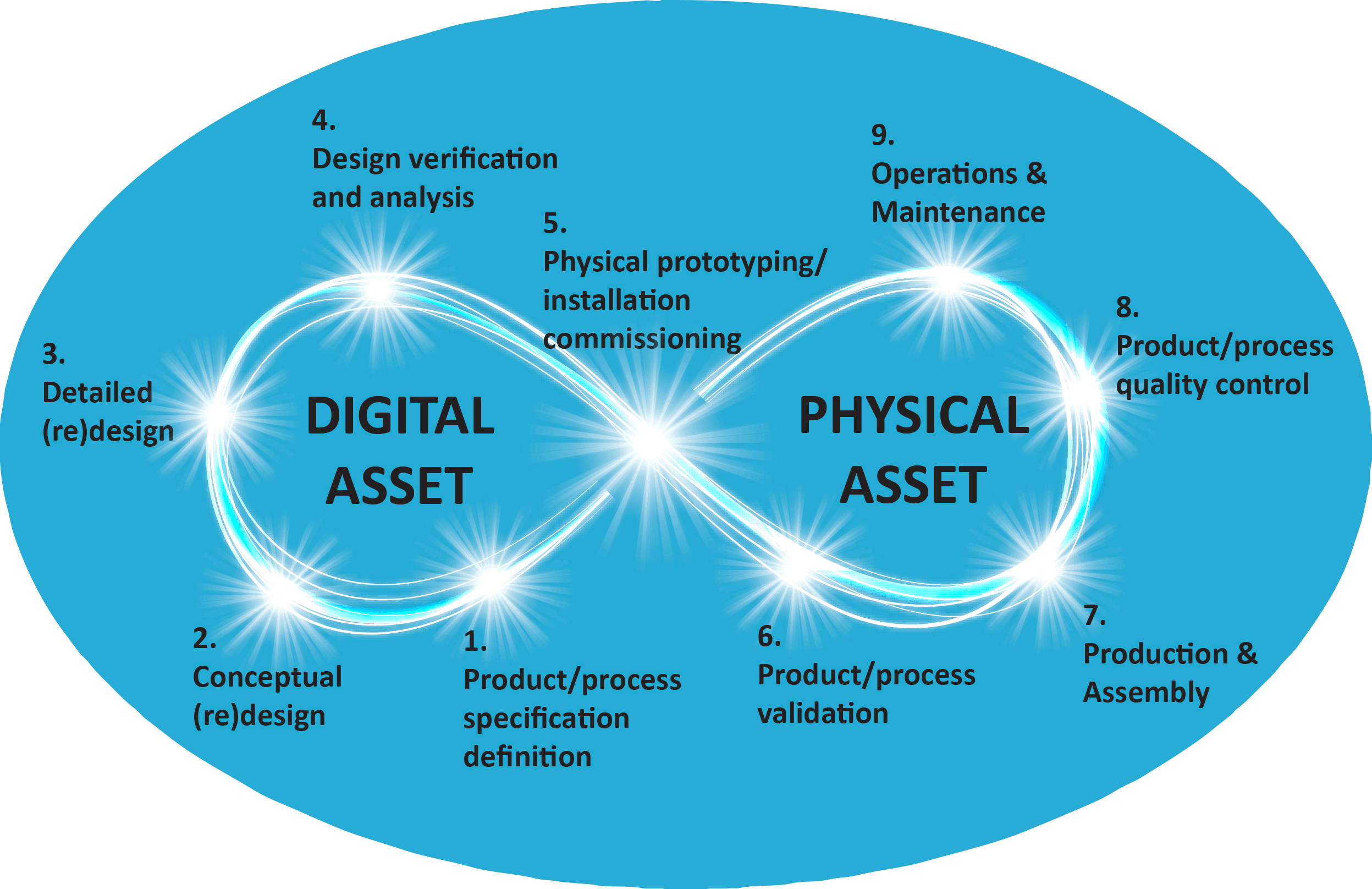
Leveraging on the concept of Digital Twins, the manufacturing industry is on the verge of fully exploiting Industry 4.0’s digitalization potential. Digital information (digitized knowledge, simulation models, test data, production data, etc.) is becoming available in potentially large amounts during the different stages of product design and manufacturing: from early concept design, over detailed design and analysis, virtual and physical prototyping, product validation, commissioning, production and assembly, quality control, the operational product in‐use stage, and even the end‐of‐life (re‐use, re‐cycling, re‐manufacturing) stages.
Digital Twins enable collecting and comprehensively managing all digital information linked to a unique product asset (from the different product design, manufacturing stages and operational usages). They allow to connect information from the stage where it is created to other stages and to generate added value by digitally connecting these stages in a closed loop. As such, the amount of available information and knowledge substantially increases and more optimized and effective decisions can be taken; for instance O&M strategies not only exploit online operational data, but also manufacturing quality data from when individual components were manufactured, quality control data capturing possibly minor quality issues, and even physical behavioral models from the product design stage exploited now for performing virtual scenario analyses to find the most optimal future operational regimes.
Advanced AI algorithms/methods will support in unleashing the true potential of straight-through-digitalization (also referred to as the infinity loop model) in manufacturing. The considered Use Case will gradually release infinity loop model data for different products and of different stages in product lifecycle. Targeted products/systems include gears and gearboxes for automotive transmissions, bike frames and visco-elastic bushing elements.
Proofs of Concept
Two proof of concepts are currently being developed.
Online estimation of the remaining useful lifetime of critical mechanical components in bicycles
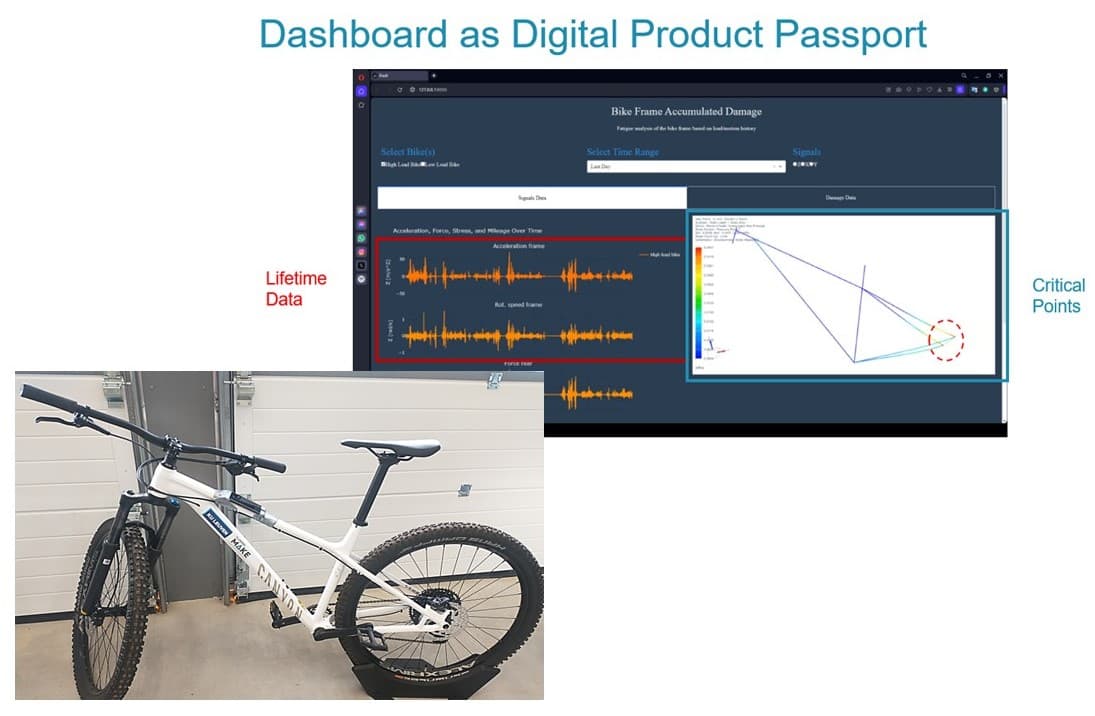
Via online measurements of vibration signals while riding a bike, physics inspired models resulting from the bike's design stages are exploited in retrieving occurring stress levels. These are used to pinpoint critical locations to inspire further improved frame redesign and in parallel fed back to the user for supporting optimal maintenance. This proof of concept is based on the development of a bike digital product passport. A running demonstrator on this proof of concept has been developed and will be further exploited in next activities.
Design, manufacturing, validation and use of gears for automotive transmissions
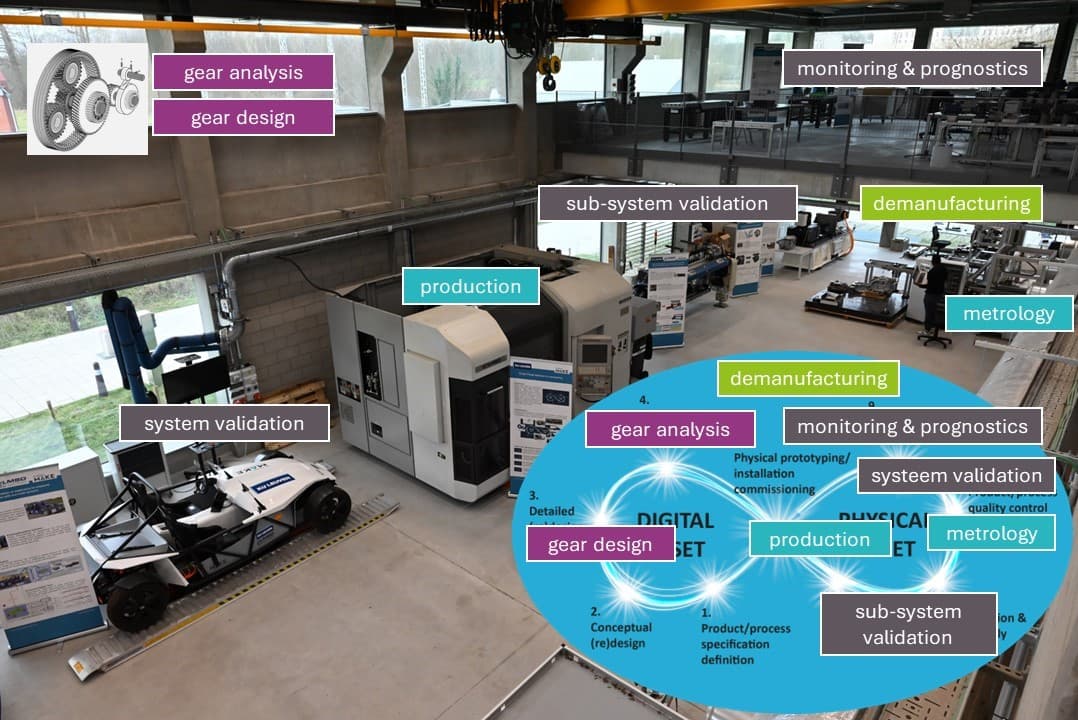
In this proof of concept, the infinity loop paradigm is deployed for the case of metal gear manufacturing. Gear design information (CAD, CAE), information from the gear manufacturing machines, metrology information, test data (dynamic) of the manufactured gears in direct gear-gear contact test benches, of the gears installed in a transmission gearbox and on full load/speed test benches and finally installed in the electric vehicle, are captured. This heterogeneous data is stored with appropriate metadata. Objective is to exploit the infinity data to run a.o. the following scenarios: (i) improved design of gears towards low-vibration & low-noise transmissions; (ii) adapting operational load cases in view of maximizing Remaining Useful Lifetime; and (iii) exploiting manufacturing data in maximizing operational lifetime of the transmissions.
During 2025, the lab became operational (see picture) with first gears being manufactured. Currently, the focus is on collecting and structuring the data whilst in parallel appealing industry stakeholders for joint research activities.
Outputs & Resources
Demonstrators / Applications
Bike digital product passport and running demonstrator for online estimation of the remaining useful lifetime of critical mechanical bicycle components.
Metal gear manufacturing proof of concept using design, production, metrology, test-bench and in-use data across the product lifecycle.
Infrastructure / Data Collection
Operational lab for the gear manufacturing proof of concept, with first gears manufactured in 2025.
Ongoing collection and structuring of heterogeneous lifecycle data for gear design, manufacturing, validation and in-use analysis.
Team & contact
Contact
UC Lead: Bert Pluymers, KU Leuven, Mechanical Engineering, LMSD (Mecha(tro)nic System Dynamics)
AI Expert Lead: Konstantinos Gryllias, KU Leuven, Mechanical Engineering, LMSD (Mecha(tro)nic System Dynamics)
Use Case Lead
Bert Pluymers, KU Leuven, Mechanical Engineering, LMSD
Principal Investigators / AI Expert Leads
Konstantinos Gryllias, KU Leuven, Mechanical Engineering, LMSD
Research Groups
LMSD, KU Leuven