
Sports
Use Case Description
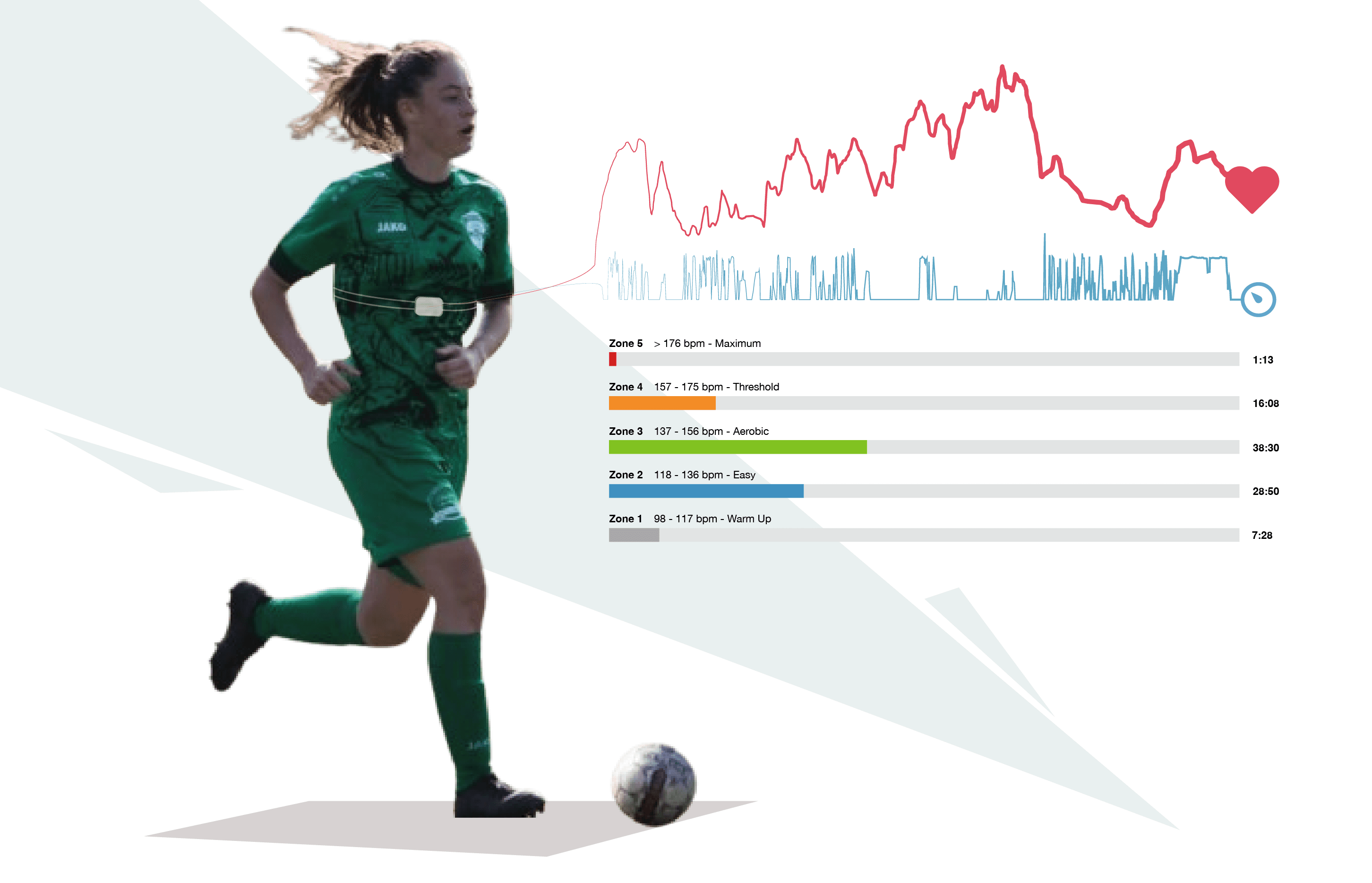
Sports play an integral role in the daily lives of many people. This can range from discussing the results of the latest match to participating in sports recreationally in either a group or individual setting. In fact, 60% of adults in Flanders report that they participate in sports at least once a week. Sports are also becoming an incredibly data-rich field with both professional and recreational sporters using inexpensive sensors such as accelerometers, GPS, and heart rate belts to monitor various aspects of their training. This data is extremely easy and cheap to collect and is much less sensitive than clinical data. Sporters are all interested in using this data to gain insights into their fitness level, track their progression over time, and guide their training.
These sensors collect multiple measurements per second and hence each activity is characterized by a large amount of data. Finding relevant insights can only be accomplished by using automated analysis techniques like artificial intelligence (AI). Unfortunately, the characteristics of the data pose a number of significant challenges from an AI perspective, including the following four key challenges:
Challenge 1: AI algorithms are not directly applicable to the data in its raw form. It is heterogeneous, multimodal, and multivariate, and it is often necessary to fuse or combine the information coming from the different signals in order to gain insights. Moreover, most standard learners work with tabular data whereas this data is sequential nature. Hence, it is necessary to construct features from the series and convert or wrangle the data into a format where standard learners are applicable.
Challenge 2: The data is noisy and often requires significant preprocessing to work with it. The data needs to be cleaned, filtered, and segmented. Moreover, it is necessary to cope with drift and changes in the underlying signals. Each tackled problem typically has its own peculiarities that need to be accounted for.
Challenge 3: It is crucial that the results of any analysis are interpretable so that sporters and coaches can have actionable insights into their physical performance. Moreover, it is important that users trust the veracity of the analysis. This requires grounding the work in knowledge about the particular domain.
Challenge 4: The nature of sports data presents a number of subtle issues from a methodological and evaluation perspective. Methodologically, dependencies affect how to perform data partitioning for evaluation as well as the need to consider contextual factors. From an evaluation perspective, achieving good accuracy is insufficient, factors such as actionability, robustness and novelty are also important.
Current AI approaches struggle to adequately cope with these challenges. On the one hand, Challenge 1 and Challenge 2 are typically approached by hand crafting a solution from scratch for each problem, which is extremely time consuming. The upshot is that the lack of automation prevents exploiting the collected data to the fullest extent possible. On the other hand, while coaches and recreational athletes are picking up on data-driven insights, the lack of interpretability means that it is hard to take actions based on the findings. Moreover, findings are often overly generic and automated approaches lack the ability to place contextualize them in an appropriate manner.
We aim to exploit the envisioned advances in the FAIR program to improve the state of practice in four ways:
[G1] - Provide ways to put sports data in the right format. This could entail developing standards (e.g., for representation and delivery) as well as algorithmic solutions such as developing partially automated techniques to feature construction, data segmentation, change point detection and preprocessing in the context of sports data. This will enable the collected data to be analyzed with much less time and effort from data scientists.
[G2] - Gracefully cope with missing, corrupted or noisy data. For example, the models should recognize if the measures are corrupted and warn the user that the predictions / findings should be ignored because they are not trustworthy.
[G3] - Demonstrate how the combination of learning and reasoning can provide additional insight and context into a model’s predictions. For example, the model should be able to recognize a new training routine or exercises and adapt its behavior accordingly.
[G4] - Provide actionable advice and best practices about how to approach methodological and evaluation issues when working with sports data.
Data Sets and Tasks
We will ground the abovementioned goals in several concrete tasks revolving around two main data sets:
Physical Therapy Data
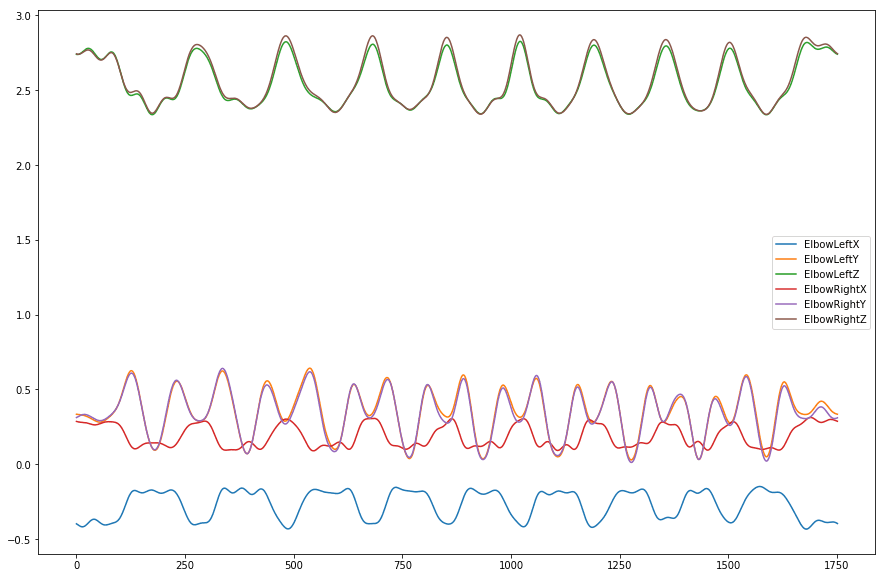
We will analyze data that we have collected about people performing common physical therapy exercises. Addressing this problem entails five concrete tasks: (1) segmenting each set of exercises into its individual repetitions, (2) selecting and representing the most relevant parts of the data, (3) predicting which exercise is being performed, (4) predicting if the exercise was performed correctly, and (5) predicting which mistake was made during the exercise, if any. These tasks use publicly available data that we have collected using a 3D depth camera.
Soccer Event Data
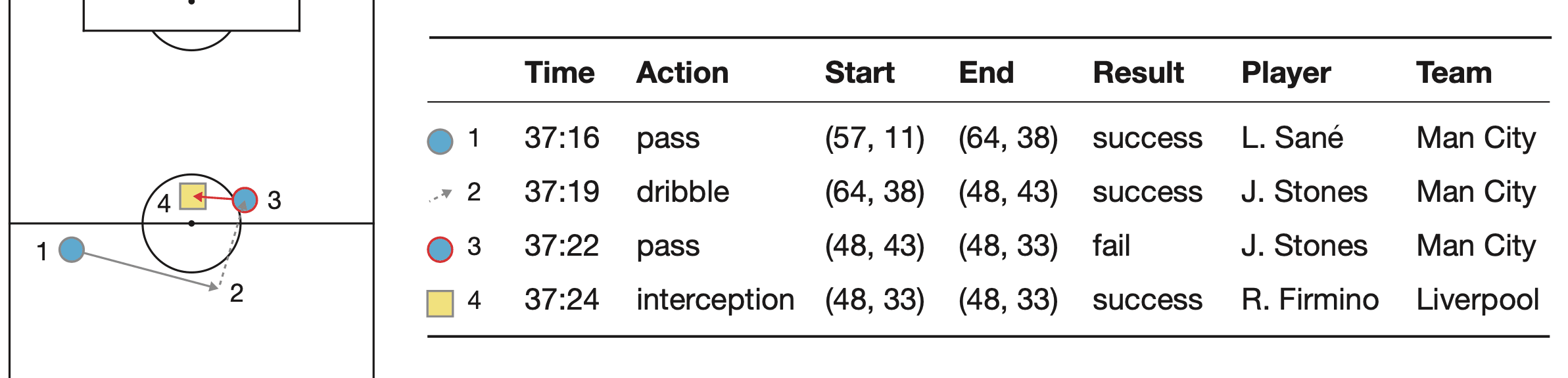
We will analyze data arising from football (soccer) matches. Specifically, we will look at event data, which records information about each on-the-ball event that occurs during a match. For this, we exploit several large public repositories of data made available by data providers (e.g., Wyscout, StatsBomb, PFF FC 2022 World Cup data). This data is identical to what clubs, federations, and media companies have access to. The concrete problems are guided by practitioners, but involve questions such as how to represent the data, simulate realistic data, analyze tactics, and evaluate performance.
Results, Highlights & Research Outputs
The key advances made in this use case include:
[G1] - Showing that our approach to channel selection results in run time improvement of between 2x-10x while maintaining the same predictive performance versus the previous state-of-the-art channel selector on the physical therapy data for the three predictive tasks.
[G1] - Contributing to establishing a standard for representing and delivering data arising from football (soccer) matches. This was done in collaboration with a small working group of international stakeholders, including representatives from national federations, clubs, and football organizations. Moreover, iterative feedback was collected from a large and broad cross-section of people in the football data ecosystem.
[G3] - Providing insights into the context needed to simulate the next event in soccer. We confirm that incorporating a longer history of past events improves prediction performance, and that including team or player identity information, despite what one may think, does not substantially enhance it. However, the co-learned embeddings do show meaningful patterns related to player roles and team-specific playing styles, which can be useful for player profiling.
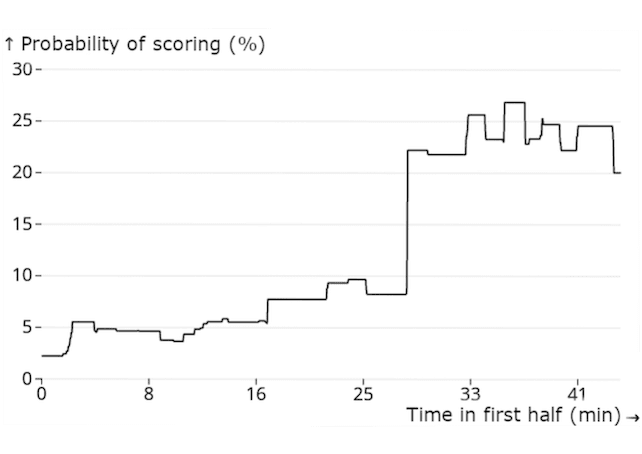
[G2,3,4] - Creating a structured framework for tackling methodological and evaluation issues in sports data, including practical examples that describe and illustrate potential pitfalls and how to avoid them. Nowadays, AI is used to build models and indicators that capture the skills, capabilities, and tendencies of athletes and teams. Designing these indicators requires paying careful attention to a number of subtle issues from a methodological and evaluation perspective. However, these issues are neither thoroughly discussed in the literature nor extensively supported in common tools, despite the fact that they consume substantially more time than, e.g., setting up training models, in the data science pipeline. The below image illustrates that for specific action sequences, the time remaining in the game has a large variable effect on the probability of scoring in the considered VAEP action model. This variability is unexpected and reveals a robustness issue with the model.
Selected highlights
CDF - A standardized format for match-data in football
During football matches, a variety of different parties (e.g., companies) each collect (possibly overlapping) data about the match, ranging from basic information (e.g., starting players) to detailed positional data. Clubs, federations, and other organizations are increasingly interested in leveraging this data to inform their decision-making. Unfortunately, analyzing such data poses significant barriers because each provider may (1) collect different data, (2) use different specifications even within the same category of data, (3) represent the data differently, and (4) deliver the data in a different manner (e.g., file format, protocol). Consequently, working with this data requires an organization to make substantial investments in terms of time and money. These costs can prevent them from fully exploiting such data.
The goal of the Common Data Format (CDF) is to provide a standardized way to represent data arising from football matches. The CDF has been developed with analysis in mind and aims to be (1) unambiguous by proposing a common schema, (2) complete by including the necessary information for analysis tasks, and (3) easily extendable to incorporate new data sources. Establishing a CDF confers many benefits as it should help alleviate some of the aforementioned pain points. The CDF has been developed by a group of key stakeholders. Moreover, the team collected feedback on the proposed format from a broad and diverse set of people active in the football data ecosystem.
TSelect - Multi-channel time series channel selection
In many time series classification tasks, each instance is described by multiple channels (i.e., signals). This introduces an additional computational burden as the time to train a classifier increases as more channels become available. This is problematic as some tasks can be described by a huge number of channels. However, not all channels may be necessary as some could be irrelevant, and including these can degrade performance. Moreover, others may contain similar information, thereby unnecessarily increasing the computational cost. Therefore, it can be useful to automatically select a subset of the channels to include in the analysis. This work proposes a novel approach called TSelect for this task that automatically selects a relevant and non-redundant subset of the channels for multivariate time series classification (MTSC). The method is generic and applicable to any time series classification approach.
LoCoMotif - Exercise detection using time series motif discovery
Time series motif discovery (TSMD) refers to the task of identifying patterns that occur multiple times (possibly with minor variations) in a time series. All existing methods for TSMD have one or more of the following limitations: they only look for the two most similar occurrences of a pattern; they only look for patterns of a pre-specified, fixed length; they cannot handle variability along the time axis; and they only handle univariate time series. This work presents a new method, LoCoMotif, that has none of these limitations. The method is motivated by a concrete use case from physiotherapy. LoCoMotif substantially outperforms the existing methods, on top of being more broadly applicable.
MC-TIRE - Multi-channel change point detection for time series
Change Point Detection (CPD) refers to the task of identifying abrupt changes in the characteristics or statistics of time series data. Recent advancements have led to a shift away from traditional model-based CPD approaches, which rely on predefined statistical distributions, toward neural network-based and distribution-free methods using autoencoders. However, many state-of-the-art methods in this category often neglect to explicitly leverage spatial information across multiple channels, making them less effective at detecting changes in cross-channel statistics. This work introduces an unsupervised, distribution-free CPD method that explicitly incorporates both temporal and spatial (cross-channel) information in multichannel time series data based on the so-called Time-Invariant Representation (TIRE) autoencoder. Evaluation illustrates the significant advantages of the proposed multi-channel TIRE (MC-TIRE) method, which consistently delivers more accurate CPD results.
Outputs & Resources
Publications
Anzer, G., Arnsmeyer, K., Bauer, P. et al. Common Data Format (CDF): A Standardized Format for Match-Data in Football (Soccer). arXiv:2505.15820 (2025)
Cao, Z., Seeuws, N., De Vos, M., and Bertrand, A. Change Point Detection in Multi-Channel Time Series Via a Time-Invariant Representation. IEEE Transactions on Knowledge and Data Engineering (2023)
Davis, J., Bransen, L., Devos, L. et al. Methodology and evaluation in sports analytics: challenges, approaches, and lessons learned. Mach Learn 113, 6977–7010 (2024)
Davis, J., Robberechts, P. Biases in Expected Goals Models Confound Finishing Ability. Workshop on Machine Learning and Data Mining for Sports Analytics (2023)
Nuyts, L., Perini, L., and Davis, J. TSelect: selecting relevant and non-redundant channels for multivariate time series classification. Data Min Knowl Disc 39, 76 (2025)
Olthof, S., Davis, J. Perspectives on data analytics for gaining a competitive advantage in football: computational approaches to tactics. Science and Medicine in Football, 1–13 (2025)
Robberechts, P., Van Roy, M., and Davis, J. Un-xPass: Measuring Soccer Player's Creativity. In Proceedings of the 29th ACM SIGKDD Conference on Knowledge Discovery and Data Mining (KDD 2023)
Romero, R., Mashayekhi, Y., Lai, F., Van Roy, M., De Bie, T., and Davis, J. Next-Event Prediction in Soccer: Assessing the Impact of Team and Player Information. Workshop on Machine Learning and Data Mining for Sports Analytics (2025)
Schepers, M., Robberechts, P., Van Haaren, J., and Davis, J. What Makes a Dribble Successful? Insights From 3D Pose Tracking Data. Workshop on Machine Learning and Data Mining for Sports Analytics (2025)
Van Roy, M., Cascioli, L., and Davis, J. ETSY: A rule-based approach to Event and Tracking data Synchronization. Workshop on Machine Learning and Data Mining for Sports Analytics (2023)
Van Roy, M., Robberechts, P., Yang, W.-C., De Raedt, L., and Davis, J. A Markov Framework for Learning and Reasoning About Strategies in Professional Soccer. Journal Of Artificial Intelligence Research 77 (2023), 517–562
Van Wesenbeeck, D., Yurtman, A., Meert, W. et al. LoCoMotif: discovering time-warped motifs in time series. Data Min Knowl Disc 38, 2276–2305 (2024)
Software & Tools
ETSY (synchronizing event and tracking data in soccer)
LoCoMotif (discovering time-warped motifs in time series)
OC-Score (detecting adversarial examples in tree ensembles)
socceraction (objectively quantifying a soccer player's impact using event stream data)
soccer_xg (training and analyzing expected goals (xG) models in soccer)
TSelect (channel selection for multivariate time series classification)
TSFuse (automatically constructing features from multiple time series)
un-xPass (measuring soccer players' creativity)
veritas (verification tool for tree ensembles)
Media & blog posts
Sports analytics blog: https://dtai.cs.kuleuven.be/sports/blog. Recent highlights include
Our work has appeared in various media, a list is maintained here. Some of the highlights are:
https://www.theguardian.com/football/2025/jun/03/soccer-analytics-jesse-davis-leuven
https://olympics.com/ioc/news/ioc-takes-the-lead-for-the-olympic-movement-and-launches-olympic-ai-agenda (accompanying video)
https://fivethirtyeight.com/features/is-soccer-wrong-about-long-shots/
External events / workshops
Workshop on Machine Learning and Data Mining for Sports Analytics (MLSA)
Tutorial on Team Sports Analytics @ECML2024
Dagstuhl Seminar on "Computational Approaches to Strategy and Tactics in Sports"
Team & Contact
Contact
Jesse Davis and Wannes Meert
Use Case Lead(s)
Jesse Davis and Wannes Meert
PhD Researchers
Mustafa Enes Aydin, Zhenxiang Cao, Loren Nuyts, Meng Shang, Shakir Showkat Sofi, Luca Stradiotti, Daan Van Wesenbeeck, Allen Wang, Raphaël Widdershoven, Weiyi Xu
Postdoctoral Researchers
Yoosof Mashayekhi, Raphaël Romero, Maaike Van Roy, Chunzhuo Wang
Research Groups
DTAI (Jesse Davis, Wannes Meert, Hendrik Blockeel)
STADIUS (Alexander Bertrand, Lieven De Lathauwer, Bart Vanrumste)
IDLab-UGent (Tijl De Bie, Jefrey Lijffijt)