
Smart monitoring: Power-efficient anomaly detection on high-frequency sensor data
FAIR 1 Archive Notice
This page describes research activities and results from the FAIR 2019-2023 program period.
The content is retained for reference purposes and is no longer actively maintained. Information on this page, including research outputs, team members, contact details, collaborations and links, may be incomplete or outdated.
No direct successor use case has been defined within the FAIR 2024-2028 program. Please consult the current FAIR use cases for related research activities.
Use Case Description
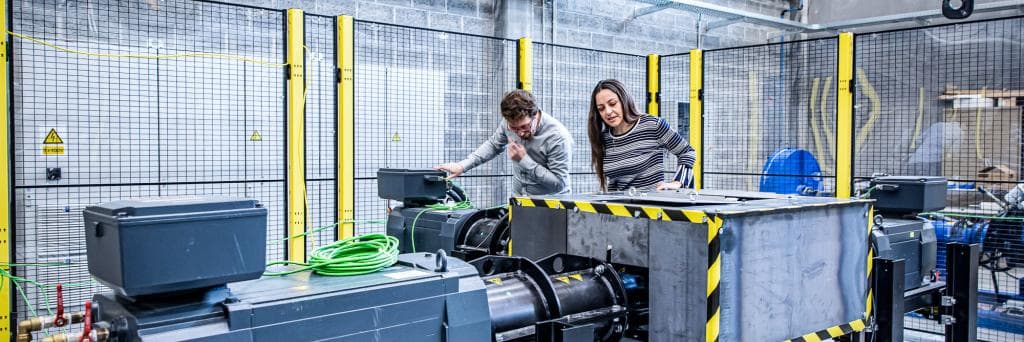
The use case demonstrates two main research topics: (i) the effect of training data-efficient AI models with scarce datasets which contain minimal number for defects / anomalies (which is the case in industry). (ii) the deployment of energy efficient AI models for real-time anomaly detection using spiking AI models and accelerated edge processing.
Results & Achievements
In 2021, the AI models, trained mainly with nominal data (no defects) and different proportions of defects data, have been evaluated, against Physics based models for bearing anomalies detection and proved 7x earlier detection of anomalies where operation regimes are constant. Wavelet Scattering method proved to be the most data efficient where only 10% defects data are needed.
In 2022, the Wavelet Scattering method was extended with physics knowledge and trained with data where operations conditions (speed and load) are changing. However, it was concluded that the original Wavelet Scattering (without physics knowledge) outperformed the one with physics knowledge, mainly due to the pruning of the model’s layers. However, from energy point of view, the addition of physics knowledge (resulting into pruned model) proved a better model’s energy-efficiency.
In 2023, a full POC with a data flow from acquisition to dashboard has been developed and demonstrated. This POC integrates the work of all involved research labs in a complementary way. Beside this POC development, new AI networks relevant for energy & data efficiency have been further elaborated and studied, leading to couple of joint publications as indicated below.
Publications
C. V. Heck, J. Wauters, T. Staessens, G. Creveceour and T. Ooijevaar, "Early Inner Race Fault Detection On A Ball Bearing Setup Using Histogram of Oriented Gradients and Wavelet Subselection," 2023 IEEE/ASME International Conference on Advanced Intelligent Mechatronics (AIM), Seattle, WA, USA, 2023, pp. 1127-1134,doi: 10.1109/AIM46323.2023.10196283
Meire, M., Van Baelen, Q., Ooijevaar, T., & Karsmakers, P. (2023). Constraint Guided Autoencoders to Enforce a Predefined Threshold on Anomaly Scores: An Application in Machine Condition Monitoring. Journal of Dynamics, Monitoring and Diagnostics, 2(2), 144–154.
Uptake
In prospect
Outreach
Different internal & external events
Basic Use Case Information
Period
2019-2023
Contact
Abdel Bey
Research Groups
Flanders Make, KUL DMMS, KUL Geel, UGent (Guillaume Crevecoeur), VUB (Jan Helsen), imec