
Smart Machines - Monitoring & Control
Use case description
Manufacturing machines often face variations, in supply, demand, but equally in input material quality and energy costs. Accounting for these variations provides opportunities to reduce costs, but is also inherently more difficult, than using fixed costs and assuming the behavior does not vary over time. In this use case we study how this affects the control of such assets, and their monitoring. For the first the goal is to ensure robust performance, reducing cost and maximizing productivity, by adjusting to the specific conditions, and not relying on conservative setpoints. For the second the goal is to ensure the condition and health of machines can be correctly assessed, even though their usage differs, accurately and without conservatism.
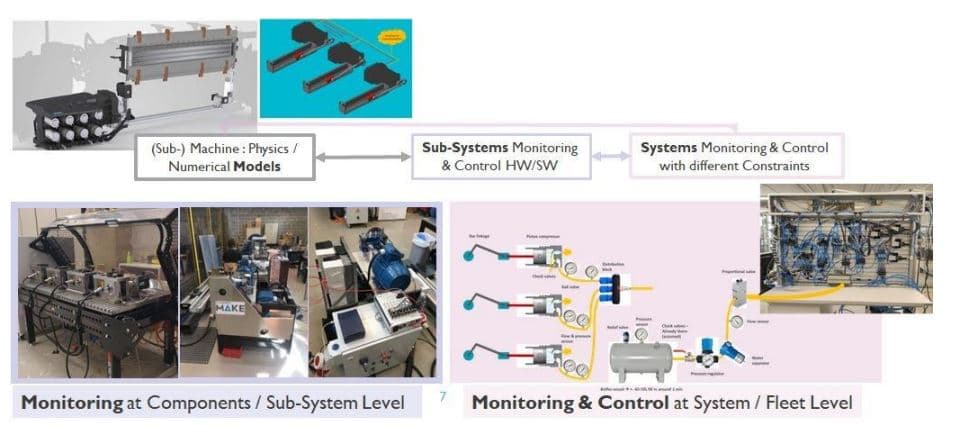
Two Flanders Make Infrastructures are being used to generate relevant data and to develop AI-enabled techniques to control & monitor machines under variable usage and operation profiles. We are now working on:
A setup with multiple cooling units, for which we are making a controller that optimally coordinates when to use which unit and at what power, to meet a variable cooling demand. This builds on prior work where we applied similar methods to control a set of multiple compressors. Similar to that case, we are now working on comparing typical industrial rule-based or classical model-based control methods to control the cooling units, with reinforcement learning.
A setup with an easily accessible machine drivetrain, in which various components can be altered or replaced. For now we are using this to generate drivetrain data wherein a belt is either correctly tensioned or not. We are now comparing several methods to perform anomaly detection on this dataset, when the data is not only recorded in well controlled steady state conditions, but also during transients, and will later also consider different types of flawed data (noise, gaps, lacking labels, ..).
From 2026 onwards we will replace the existing drivetrains of the chillers with versions similar to the one being used for condition monitoring now, so we can for the cooling setup also include failures. This will then allow to study RCA, to monitor the condition of the units at system level, .. and to eventually also do condition or health aware control of the cooling units.
Results, Highlights & Research Outputs
RL control for coordinating chillers / cooling network
We have recently shown that for coordinating chillers, an RL policy can be trained to match the performance of a well-performing MPC controller. In fact, while the MPC achieves a good outcome by exploiting preview of the future cooling demand, the RL does not need this, as it has instead implicitly learned to exploit the typical usage profiles present in the training data. Future work will focus on studying the impact of poor training environments (dynamics, but also usage patterns), and how to avoid this leading to pro-longer finetuning after transfer from training to setup.
Publication
Jeroen Willems, Denis Steckelmacher, Wouter Scholte, Bruno Depraetere, Edward Kikken, Abdellatif Bey-Temsamani, Ann Nowé. "Reinforcement Learning for model-free control of a cooling network with uncertain future demands". Nominated for best paper award, to be presented at ICINCO 2025.
Condition monitoring for belt fault detection under varying conditions
With respect to condition monitoring, we have collected faulty and healthy data of a belt in various conditions. On it, we have shown that despite variations in the conditions, detection of faults can still be done using AI methods. However, this was still with with cleanly labeled data and a full sensor suite, whereas in future work we will now study how to ensure robustness when more variations are introduced, and both data and sensor quality degrade.
Outputs & Resources
Publications
Jeroen Willems, Denis Steckelmacher, Wouter Scholte, Bruno Depraetere, Edward Kikken, Abdellatif Bey-Temsamani, Ann Nowé. "Reinforcement Learning for model-free control of a cooling network with uncertain future demands". Nominated for best paper award, to be presented at ICINCO 2025.
Infrastructure / Data Collection
Multiple cooling units / chillers setup for coordinating variable cooling demand.
Machine drivetrain setup for belt condition monitoring under varying conditions.
Future replacement of existing chiller drivetrains from 2026 onwards to include failures in the cooling setup.
Previous Realizations
AI for condition monitoring & health prognostics of rotary parts:
AI for optimal control of machines fleet:
Team & Contact
Contact
Bruno Depraetere (Use case owner / Control Expert) / Kerem Eryilmaz (Monitoring Expert) - Flanders Make IM
Industry Use Cases follow up & Valorization: Wouter De Nijs / Abdel Bey - Flanders Make IM
Use Case Lead(s)
Bruno Depraetere, Flanders Make IM