
Self-Sustainable Micro-Grids
FAIR 1 Archive Notice
This page describes research activities and results from the FAIR 2019-2023 program period.
The content is retained for reference purposes and is no longer actively maintained. Information on this page, including research outputs, team members, contact details, collaborations and links, may be incomplete or outdated.
No direct successor use case has been defined within the FAIR 2024-2028 program. Please consult the current FAIR use cases for related research activities.
Use Case Description
Goal of the use case:
Solving the sustainable energy problem is one of the great challenges of our modern-day society. While access to affordable energy should be a basic right for every citizen, the move to clean energy is vital for the Flemish government to meet its carbon emission reduction targets. In the past support policies for installing small-scale renewable energy systems in domestic households have been implemented, examples are net metering and long-term contracts. Unfortunately in many cases, these policies lead to overproduction which can put a lot of stress on the grid. This is not scalable and very expensive to maintain and very importantly, there is no incentive to use green energy.
In our use case, we are focusing on micro-grids, local electrical grids, where producers and consumers can produce and exchange energy. This is a very complex system containing multiple connected decentralized devices and hence many difficult decision problems.
We focus on two challenges:
How can we delegate the task of exchanging green energy to intelligent agents and how can we apply multi-agent systems techniques to control all these devices? How can we optimize this system for all stakeholders and still balance the grid?
How do humans approach the problem of managing their devices in such a complex interconnected system? What is needed to make an informed decision? How can trust in intelligent agents acting on their behalf be established? And how can we use these results in designing the agents in the first challenge?
Although we are focusing on distributed energy, the results of this use case are also relevant to the management of other scarce resources, such as traffic routes and water systems, which, aggravated by the climate change problem, has become more and more challenging in Flanders.
To tackle the first challenge, we designed a control policy based on the NRGcoin mechanism for the exchange of renewable energy. This mechanism is used to obtain an equilibrium between injection and consumption in each neighborhood and offers cheaper green energy across different neighborhoods. Prosumers are incentivized to balance their production out of their own self-interest and are discouraged from overproducing. Consumers and prosumers can buy green energy at cheaper prices, even in neighborhoods with different compositions. Conducting experiments with humans in the second challenge has provided insights into how to further optimize the different agents. For instance, how should the reward function be designed and what happens if people have a say in the decisions.
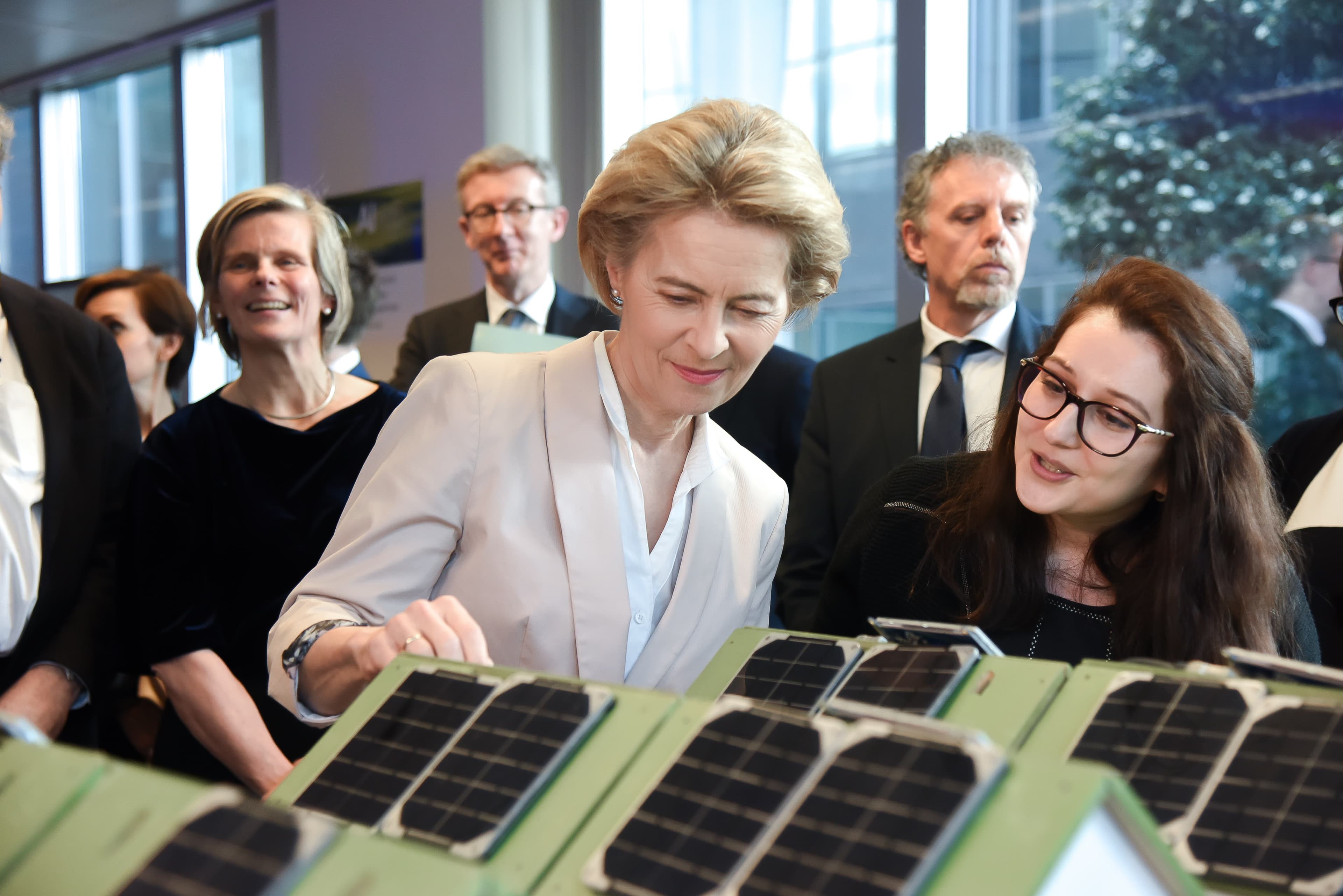
To illustrate the results, we have designed a simulation framework that can be used to test different scenarios, and different agents and detect where improvements can be made, e.g. in this neighborhood more solar panels can be added. These scenarios can also be tested in a demo setup at the VUB AI Lab using miniature solar panels and an artificial sun.
For the second challenge, we designed and performed an experiment where participants played a game to decide on resource extraction levels. The game involved groups of four participants who, over ten rounds, chose how much to extract from a shared resource. The study tested three scenarios: a pro-social default advocating optimal resource use, a self-serving default leading to resource depletion, and a control with no default value. Participants could adjust their extraction levels and were informed of others' decisions and their own payoffs. Results showed that default values influenced extraction levels for the initial five rounds, after which individual preferences prevailed. Participants who were risk-averse were more likely to adhere to the default values. The study's insights can enhance smart grid management by suggesting pro-social default settings for energy use. This approach could initially guide users towards efficient energy consumption. However, our study also highlights the perils of using “bad” defaults as well, which can hinder sustainable energy management. The findings we have are important for designing smart grid interfaces and policies that account for individual heterogeneity in finite resource extraction.
Results-Artefacts
Demonstrator
NRGcoin
Journal/Conference Publications:
Montero-Porras, E., Lenaerts, T., Gallotti, R., & Grujic, J. (2022). Fast deliberation is related to unconditional behaviour in iterated Prisoners’ Dilemma experiments. Scientific Reports, 12(1), 20287. [20287]. https://doi.org/10.1038/s41598-022-24849-4
Montero, E., Grujic, J., Fernandez Domingos, E., & Lenaerts, T. (2022). Inferring strategies from observations in long iterated Prisoner’s dilemma experiments. Scientific Reports, 12(1), [7589]. https://doi.org/10.1038/s41598-022-11654-2
Toolbox used
EGT-Tools
PhD
Eladio Montero
Uptake
Related or follow-up projects
Flux 50 ICON OPTIMESH
Contact
UC Lead: Prof. Ann Nowé - VUB Artificial Intelligence Lab
Basic Use Case Info
Period
2019-2023