
Renewable Energy Production
Use Case Description
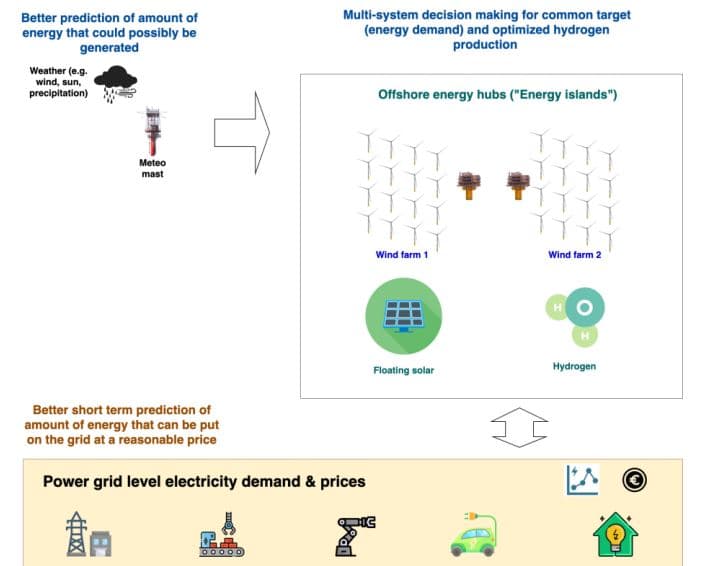
This Use Case targets the optimized production of electricity in a combined offshore ecosystem consisting of wind turbines, hydrogen plants, and potentially floating solar. We aim to meet grid energy demand, while optimizing the production of green hydrogen as energy storage medium. The goal is to facilitate individual decisions for each of the energy production units, while allowing to meet greater goals over the different units. Targets are to predict and meet expected grid demand on the short and near term (day ahead, next 15-minutes), as well as producing hydrogen at minimal cost. Excess power should be used to produce green hydrogen.
AI methods are needed to make these decisions in an optimal way. Given that all energy production units are distributed and take individual decisions, AI methods linked to game theory and reinforcement learning offer large potential for optimizing targets over multiple agents (grid demand and cost of hydrogen production), while allowing agents to take individual decisions. This Use Case facilitates the validation of such multi-agent optimized control algorithms. In addition, novel timeseries forecasting methods can be validated, given that accurate weather forecasts as well as expected market behavior forecasts are essential for solving the distributed production challenges. This Use Case aligns with the strategic road map of the EU through the Green Deal as well as with the “Vlaamse Veerkracht” in Flanders where renewable energy rollout at a high pace is crucial. Offshore energy hubs, consisting of wind farms, hydrogen production and potentially floating solar, will play a crucial role in this green transition. Farms will be built further offshore because floating wind technology is becoming available. This increases the need for optimized use of electricity cables as well as localized hydrogen production. The key to be able to do such combination of different renewable energy sources in a local ecosystem is the availability of optimized control and prediction methods. Such methods need to balance the production of each of the distributed units of the entire energy hub (wind, hydrogen, solar) as a common greater good while allowing individual decisions. A core underlying aspect is being able to accurately assess expected market and weather behavior. Flemish companies are today already at the forefront of the offshore industry (e.g., Parkwind, Otary, Elicio), as well as in the proof-of-concept realization of green hydrogen production (e.g., Fluxys, Colruyt Group). This Use Case can help with crucial AI based control to create these offshore energy hubs.
Results, Highlights & Research Outputs
Prediction of offshore wind farm power production and wake loss by deep learning
The power output of an offshore wind farm is influenced by numerous parameters, with wake effects playing a particularly significant role. To address this complexity, we developed a data-driven forecasting approach based on deep learning. The resulting farm-level power model achieves both high accuracy and computational efficiency, making it well-suited for deployment as a digital twin in reinforcement learning training environments [Ally2025].
Optimizing the total revenue of a hybrid offshore wind farm with electrolyser unit
Hybrid offshore wind farms can generate revenue from multiple sources, including day-ahead power trading, balancing services, and hydrogen production, each subject to uncertainties and trade-offs. Operational decisions must be made at different times, under varying levels of information accuracy. To address this complexity, the problem has been formulated as a multi-agent reinforcement learning problem, resulting in a significantly increased revenue compared to conventional approaches [Ally2025b].
Enrichment project: TAFO-KG – Toolbox for automated failure diagnosis using ontology-based knowledge graphs for heterogeneous industrial machines (2025)
Machine data often suffers from a lack of standardization due to variations in components, sensors, and signal naming. This makes cross-machine analysis and modelling difficult. At the same time, the growing availability of machine data has increased complexity, making manual analysis and pattern detection impractical and highlighting the need for automated approaches to handle high-dimensional data.
This project addresses these challenges through a toolbox that:
Automatically generates a machine ontology using expert knowledge and pattern mining.
Builds knowledge graphs and provides methods for interpreting them for failure diagnosis across heterogeneous machines.
The toolbox integrates methods developed in earlier initiatives (e.g., FAIR, ICON, and EU projects) with the aim of moving them closer to production readiness. A first version has been completed and tested on both synthetic data and data from a real operational wind farm. Validation is ongoing, and current work focuses on improving scalability and robustness. The toolbox will be made open-source once finished.
Outputs & Resources
Publications:
Ally, S., T. Verstraeten, P.-J. Daems, A. Nowé, and J. Helsen (2025). Modular deep learning approach for wind farm power forecasting and wake loss prediction. Wind Energy Science, 10(4):779–812. https://doi.org/10.5194/wes-10-779-2025
Ally, S., T. Verstraeten, A. Nowé, and J. Helsen (2025b). Day-ahead trading and power control for hybrid wind-hydrogen plants with multi-agent reinforcement learning. Applied Energy, 401:126588. https://doi.org/10.1016/j.apenergy.2025.126588
van Binsbergen, D., Daems, P-J., Verstraeten, T., Nejad, A. R., & Helsen, J. (2024). Scalable SCADA-Based Calibration for Analytical Wake Models Across an Offshore Cluster. Journal of Physics: Conference Series, 2745, [012014]. https://doi.org/10.1088/1742-6596/2745/1/012014.
van Binsbergen D. et al. (2024) Performance comparison of analytical wake models calibrated on a large offshore wind cluster. Journal of Physics: Conference Series, 2767 092059. https://doi.org/10.1088/1742-6596/2767/9/092059
M. Bruninx, T. Verstraeten, J. Kazempour, and J. Helsen (2025). Day-Ahead Bidding Strategies for Wind Farm Operators Under a One-Price Balancing Scheme. In Proceedings of the 16th ACM International Conference on Future and Sustainable Energy Systems (E-Energy '25). https://doi.org/10.1145/3679240.3734639
Software & Tools
TAFO-KG – Toolbox for automated failure diagnosis using ontology-based knowledge graphs for heterogeneous industrial machines. The toolbox automatically generates a machine ontology using expert knowledge and pattern mining, builds knowledge graphs, and provides methods for interpreting them for failure diagnosis across heterogeneous machines. A first version has been completed and tested on synthetic data and operational wind farm data. Validation is ongoing, with current work focused on scalability and robustness. The toolbox will be made open-source once finished.
Team & Contact
Contact
UC Lead: Jan Helsen (VUB AVRG) / AI Expert Lead: Ann Nowé (VUB AI Lab)
Use Case Lead(s)
Jan Helsen, VUB AVRG
Principal Investigators / AI Expert Leads
Ann Nowé, VUB AI Lab
Research Groups
VUB AVRG, VUB AI Lab