
Recommender Systems
FAIR 1 Archive Notice
This page describes research activities and results from the FAIR 2019-2023 program period.
The content is retained for reference purposes and is no longer actively maintained. Information on this page, including research outputs, team members, contact details, collaborations and links, may be incomplete or outdated.
No direct successor use case has been defined within the FAIR 2024-2028 program. Please consult the current FAIR use cases for related research activities.
Use Case Description
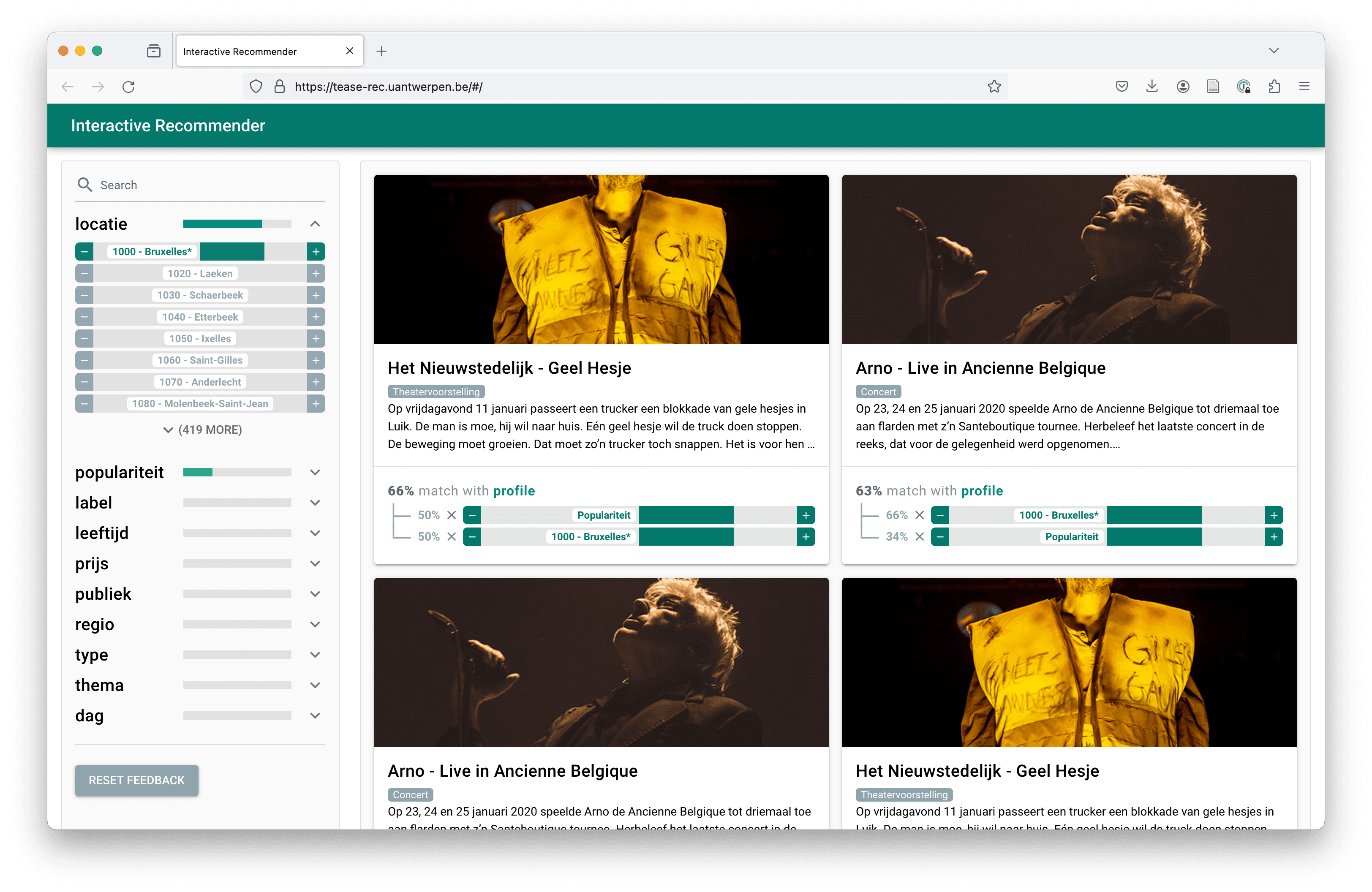
Recommender systems are used in many different applications and contexts, however their main goal can always be summarised as “connecting relevant content to interested users”. Explanations have been found to help recommender systems achieve this goal by giving users a look under the hood that helps them understand why they are recommended certain items. Furthermore, explanations can be considered to be the first step towards interacting with the system. Indeed, for a user to give feedback and guide the system towards better understanding her preferences, it helps if the user has a better idea of what the system has already learned.
To this end, we propose a linear collaborative filtering recommendation model that builds user profiles within the domain of item metadata. Our method is hence inherently transparent and explainable. Moreover, since recommendations are computed as a linear function of item metadata and the interpretable user profile, our method seamlessly supports interactive recommendation. In other words, users can directly tweak the weights of the learned profile for more fine-grained browsing and discovery of content based on their current interests. We demonstrate the interactive aspect of this model in an online application for discovering cultural events in Belgium.
Results-Artefacts
Demonstrator:
Tease-Rec: Explainable and Interactive Recommendations
TeaseR Demo https://tease-rec.uantwerpen.be
Journal/Conference publications
Basic Use Case Info
Period
2019-2023
Contact
Bart Goethals
Research Groups
Adrem Data Lab, University of Antwerp