
Prognostics and Health Management for Assets

Use Case Description
Prognostics and Health Management (PHM) is the research field that links studies of failure mechanisms to system lifecycle management. Its goal is to provide methods and tools to design optimal maintenance policies for a specific asset under its distinct operating and degradation conditions, achieving a high availability at minimal costs.
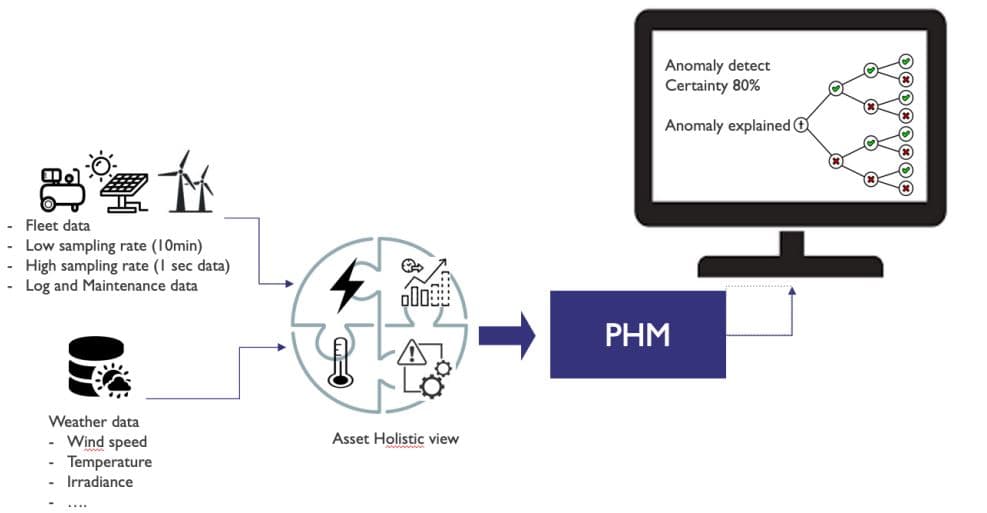
PHM can be considered as a holistic approach to an effective and efficient system health management (Lee et al., 2014). Despite the relevance of PHM methods, the state of the art is lagging in terms of research and validation on PHM methods especially for the analysis of a fleet of assets. This is due to the lack of qualitative available data in the state of the practice. Nowadays, this represents a main issue since it is becoming common for companies to operate assets in a fleet context, where identical or similar machines are used in an “array” that can be local (e.g. wind farm or factory) and/or geographically spread over the globe. In a competitive and global economy, operators / users of industrial assets strive fiercely to minimize their Total Cost of Ownership (TCO). In this context, PHM for fleet can represent a key enabler for their survival and growth.
To cope with the issues above, this use case aims to research and validate advanced AI methods to apply PHM methods with a specific focus on fleet assets. More specifically, we aim to:
Enrich the dataset via fleet data pooling. This allows to gather a wider range of operational contexts (e.g. meteorological conditions, operating modes, maintenance history, etc.) which in turn allows (i) to build models which are statistically more robust and (ii) to derive statistically more significant and more representative analytical conclusions.
Develop prototypical models at fleet level to describe the asset behavior based on the contexts and operative modes rather than the single asset historical record. This allows to cope with the cold start problem of new assets (e.g. for anomaly detection and remaining useful life estimation) and to estimate potential loss of revenue (e.g. due to downtime).
Develop fleet-based methods to benchmark assets. This allows to compare the single asset performance w.r.t the robust fleet baseline, i.e. it allows to benchmark behaviors based on achievable performance rather than theoretical one (generally extracted in lab conditions) or historical one gathered by the single asset (where the assets were potentially not correctly tuned).Develop fleet-based performance analysis. At asset level, events such as downtime and failure are generally not considered as normal, i.e. typical behaviors, since they represent exceptions during the lifetime of the asset. On the other hand, at fleet level these events become ‘normal’ since during the fleet lifetime is statically more likely to keep them appearing across the assets. By characterizing the normal behavior at fleet level allows to develop more precise PHM methods for performance analysis.
Develop decision support systems for the human stakeholders operating a fleet. This allows to conveniently zoom in and out on the information displayed or required at asset and fleet level.
Results, Highlights & Research Outputs
During the use case, several methods have been developed and validated in an industrially relevant setup (see the list of papers below). These methods propose technological solutions for context detection [2, 4, 8], transfer learning [3], hybrid modeling [5], and profiling [6], which enable the achievement of PHM tasks such as forecasting [7], classification [10], anomaly detection [8], and remaining useful life prediction [5].
More generally, we advanced in the domain of prognostic and health monitoring in two main directions:
Context extraction. We developed multiple approaches, validated in industrially relevant domains, to discover and characterize operating modes (i.e. context) without any prior knowledge of these modes. This is fundamental since operating mode detection (i.e. context detection) is required to develop tailor-made anomaly and failure detection algorithms and remaining useful life forecast. Furthermore, we developed a method to identify spatiotemporal contextual factors and understand intra-asset dependencies. The latter groups asset alarms within complex distributed systems, offering a valuable tool for general event management in diverse environments.
Hybrid modeling. We further advanced in the domain of hybrid modeling (i.e. combination of data-driven and physics-based model) by developing a method for remaining useful life estimation
Several of these methods will be embedded in a demonstrator for the purposes of testing and comparison.
Outputs & Resources
Publications
E. Tsiporkova, C. Harsha, M. De Vis, and R. Verbeke. Deriving formal concepts of 3D objects in support of additive manufacturing applications. 2024 International Conference on Industry 4.0 and Smart Manufacturing (ISM 2024).
C. Harsha, A. Murgia, E. Tsiporkova and P. Dagnely. Discovery and characterization of operating modes in a fleet of assets via hypergraph clustering. 2024 International Conference on Industry 4.0 and Smart Manufacturing (ISM 2024).
A. Beigrezaei, H. Cabral, and E. Tsiporkova. Active domain adaptation in support of reliable operating mode detection for wind turbines. 28th Knowledge-Based and Intelligent Information & Engineering Systems (KES 2024), Procedia Computer Science. 2024.
A. Eghbalian, A. Vroman, S. Klein, and E. Tsiporkova. Spatiotemporal context detection in distributed systems events with an application on network communication alarms. 28th Knowledge-Based and Intelligent Information & Engineering Systems (KES 2024), Procedia Computer Science. 2024.
A. Murgia, C. Harsha, E. Tsiporkova, C. Nawghane, and B. Vandevelde. A Hybrid Model for Prognostic and Health Management of Electronic Devices. Electronics 2024, 13, 642. 2024.
https://doi.org/10.3390/electronics13030642.V. Devagiri, P. Dagnely, E. Tsiporkova, and V. Boeva. Putting Sense into Incomplete Heterogeneous Data with Hypergraph Clustering Analysis. Intelligent Data Analysis (IDA). 2024.
M. Dhont, A. Munteanu, and E. Tsiporkova. Forecasting Traffic Progression in Terms of Semantically Interpretable States by Exploring Multiple Data Representations. IEEE Transactions on Intelligent Transportation Systems. Submitted
F. Fingerhut, M. Verbeke, and E. Tsiporkova. Unsupervised context-sensitive anomaly detection on streaming data relying on multi-view profiling. 2024 IEEE International Conference on Evolving and Adaptive Intelligent Systems (EAIS). 2024.
G. Murtas, V. Boeva, E. Tsiporkova. An evidence-based neuro-symbolic framework for ambiguous image scene classification. 19th International Conference on Neurosymbolic Learning and Reasoning. 2025.
E. Rustom, H. Cabral, S. Rajendran, and E. Tsiporkova. ShadowScout: Robust Unsupervised Shadow Detection for RGB Imagery. 20th International Conference on Computer Vision Theory and Applications (VISAPP 2025). 2025.
Outreach
On June 11th, 2024, the use case was presented at the Flander AI Forum
On June 11th, 2024, PI Elena Tsiporkova presented part of the research activities performed in the use case at the Flander AI Forum in the talk: "Putting Sense into Heterogeneous Portfolio of Industrial Assets with Hypergraph Clustering Analysis"
On January 7th, 2025, Seminar for the Arenberg Doctoral School of KUL “Meet the jury!”; title of the presentation is "Multi-View Data Exploration Recipes for Making Sense of Real-World Data”, https://set.kuleuven.be/phd/seminars/tsiporkova
On June 12th, 2025, presentation at Highway VAIA in the talk: "Data Exploration Recipes for Making Sense of Multi-Source Industrial Data "
Uptake
Related project: An industry compliant methodology for contextual performance profiling and anomaly detection (Compact). Enrichment Project (May 2024 - September 2024). The project aims to deliver an industry compliant implementation of a methodology for contextual performance profiling and anomaly detection for industrial assets.
Team & Contact
Contact
UC Lead: Alessandro Murgia, Elena Tsiporkova. Sirris
Use Case Lead(s)
Alessandro Murgia, Sirris; Elena Tsiporkova, Sirris
Principal Investigators / AI Expert Leads
Mathias Verbeke, KU Leuven - DTAI; Jesse Davis, KU Leuven - DTAI; Hendrik Blockeel, KU Leuven - DTAI; Konstantinos Gryllias, KU Leuven - LMSD
PhD Researchers
Michiel Dhont (PhD completed in 2024); Fabian Fingerhut; Giulia Murtas
Research Groups
Sirris (Elena Tsiporkova)
DTAI - KU Leuven (Mathias Verbeke, Jesse Davis, Hendrik Blockeel)
LMSD - KU Leuven (Konstantinos Gryllias)