
People Detection and Tracking
FAIR 1 Archive Notice
This page describes research activities and results from the FAIR 2019-2023 program period.
The content is retained for reference purposes and is no longer actively maintained. Information on this page, including research outputs, team members, contact details, collaborations and links, may be incomplete or outdated.
No direct successor use case has been defined within the FAIR 2024-2028 program. Please consult the current FAIR use cases for related research activities.
Use Case Description
AI-based object detection is a key component in industrial automation, with direct impact on safety and efficiency of robot operation, and offering paths to automated quality control and asset management. Deep learning based object detectors have made huge progress over the last decade, but the academic revolution in this field has so far not translated into a similar revolution in industrial practice. The main obstacle is the lack of robustness of the models. The performance reported in literature can be very different from actual performance in a real deployment. A first reason for this is that models are typically trained on generic, too easy datasets. A second reason is that models are trained and evaluated for average performance, potentially at the sacrifice of worst-case performance. Models that work well on average, can still perform unacceptably poor in a subset of cases.
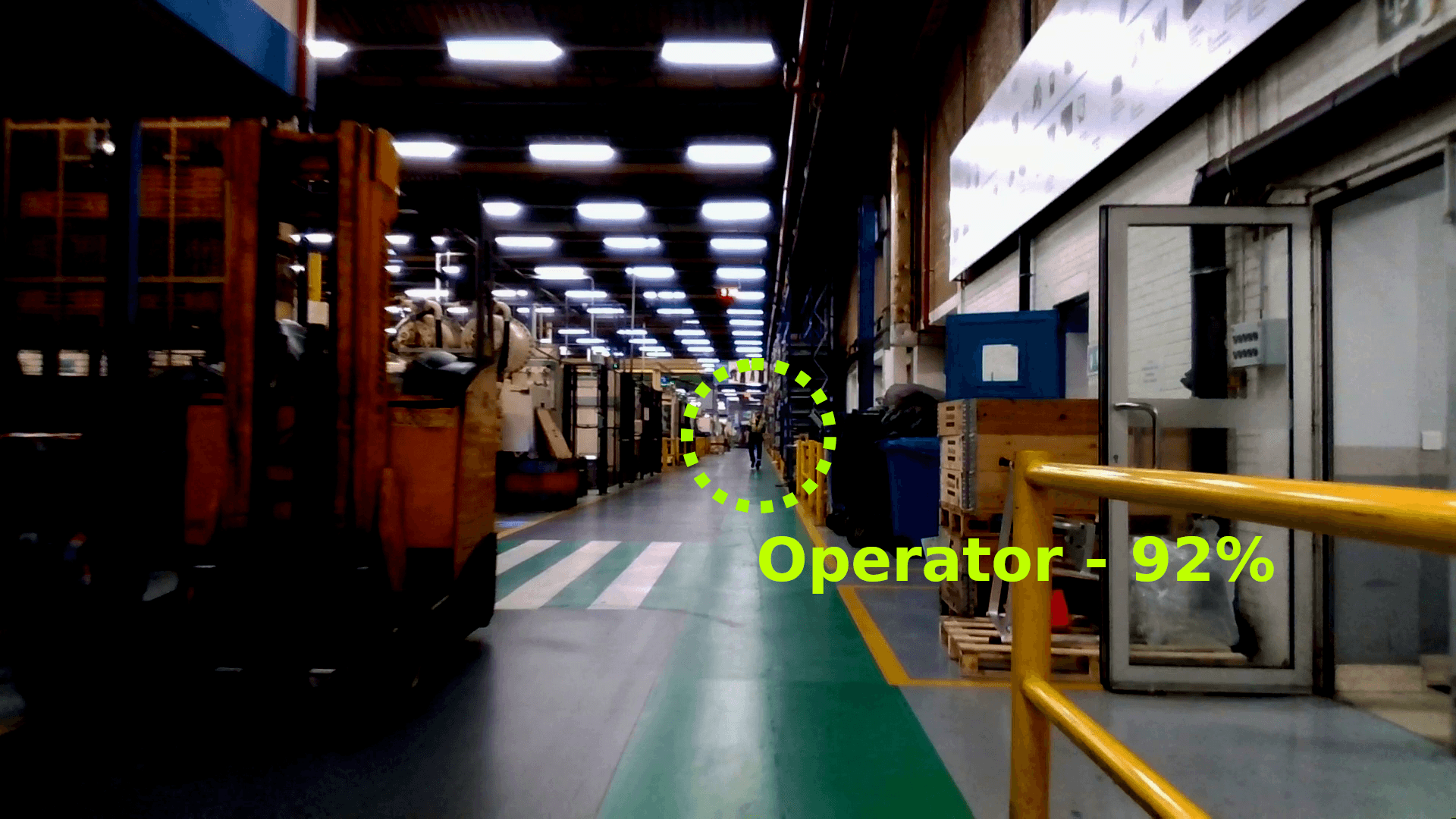
In this use case, we focus on the task of quickly and reliably detecting human operators in an industrial environment. This is a direct requirement for safe and efficient operation of AGVs in shared workspaces, and has additional applications in security & surveillance and process optimization.
Results
A novel perception system was developed to detect situations where operators suddenly cross the path of a mobile robot. Rather than using a single camera and single-frame detection, the system uses an array of two or more low-spec camera sensors placed side-by-side, and a time buffer in which a limited history of frames of each camera is saved. Parts of the camera frames across different times are compared to quickly assess whether an object is stationary or in motion. This allows to respond more quickly to surprise crossing scenarios, with a 25% reduction in detection latency compared to a single-camera YOLO model.
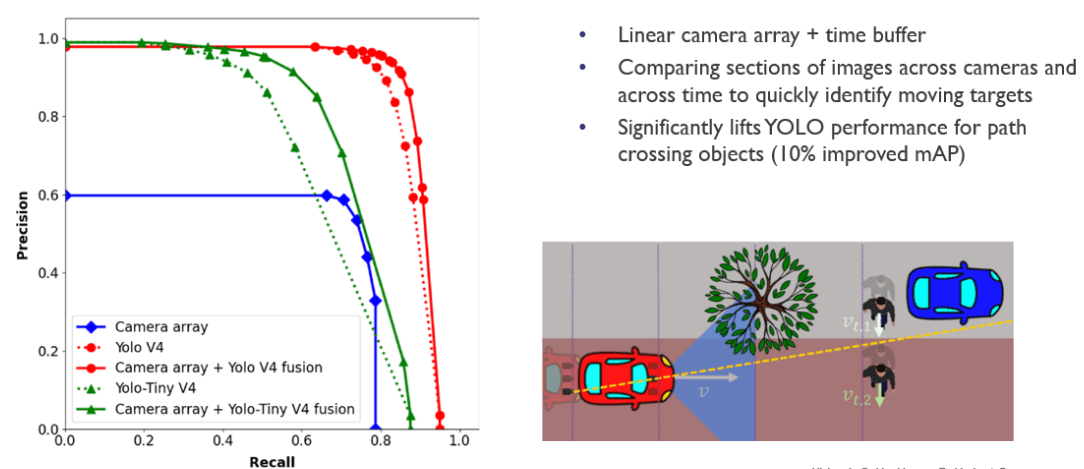
Another result is focused on reducing performance variations across different circumstances. A probabilistic calibration layer is developed that translates detection confidence output into a consistent level of evidence that takes into account the observation conditions. The concept is proven by first conditioning on object distance, which is very simple to estimate even using a single camera sensor, and this already results in up to 15% better object detection performance compared to a one-size-fits-all interpretation of detector output.
Outreach
These results were demonstrated to industrial and academic audiences at events such as ITF, AI Flanders Research day, iKnow Innovation Day, in addition to being published in computer vision conferences and journal articles.
Uptake
This research contributed to an ICON proposal about high-accuracy multi-modal object tracking and resulted in participation in two European projects about maritime safety.