
Optimization of manufacturing processes
FAIR 1 Archive Notice
This page describes research activities and results from the FAIR 2019-2023 program period.
The content is retained for reference purposes and is no longer actively maintained. Information on this page, including research outputs, team members, contact details, collaborations and links, may be incomplete or outdated.
No direct successor use case has been defined within the FAIR 2024-2028 program. Please consult the current FAIR use cases for related research activities.
Use Case Description
The additive manufacturing (AM) industry needs to be able to deliver products with a consistent high-quality for it to gain widespread usage in the industry. To deliver high quality, AM needs to have means for a quality control on the printed part, a monitoring system that can predict the quality already during the printing and eventually a closed-loop control of the 3D printing process to improve quality and reduce resource usage.
The main goals are the research of both offline and online methods to detect defects and determine their probable cause.
1. an AI offline method to automatically detect, localize and classify defects from computed tomography (CT) data. CT is a nondestructive method that allows an expert to assess the local quality of the part.
2. hardware and software for an online closed-loop control system to increase quality and productivity.
Demonstrators
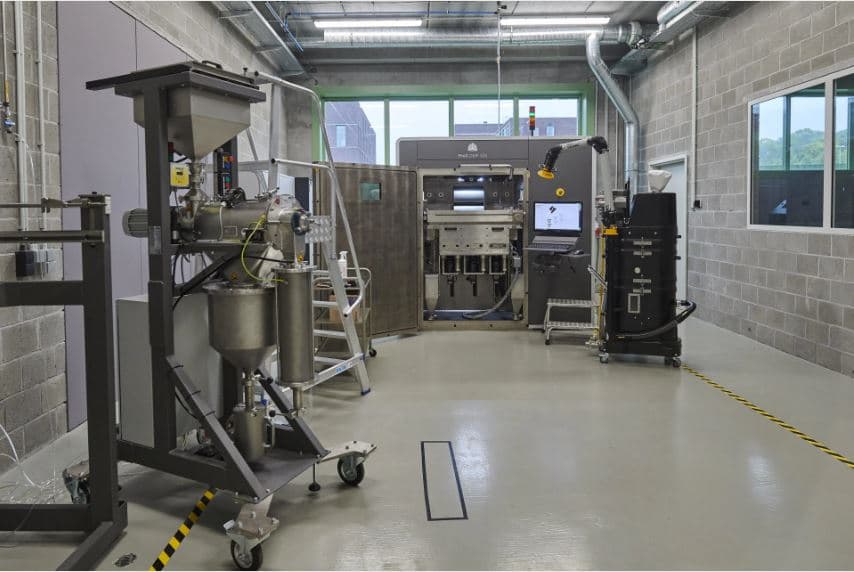
The experimental setup is an open and modular platform for research into the 3D printing process. It is built on top of an industrial printer with building volume of 275 x 275 x 400 mm able to print in metal (316L stainless steel) using selective laser melting. It is equipped with an open control platform and has extensive monitoring capabilities. Sensors are used including the ones many 3D printers are already instrumented with such as high speed photodiodes (up to 100KHz) and cameras (up to 20KHz).
Defect Detection in printed parts (offline)
A 3D-CONV-GAN generative network has been trained to reconstruct a defect-free 3D structure of a printed object from its CT data. In this way it is possible to automatically detect and localize defects by comparing the reconstructed structure with its original CT data. This method highlights the defects faster and with more precision than the classical methods.
Defect Detection during printing (online)
In order to enable the real-time detection, a technique for fast anomaly detection on time series using extreme learning machines have been implemented. It uses both a 3D-CNN and a LSTM network capable to analyze data coming from high-speed sensors (e.g. a 20Khz video feed) monitoring the melting process in order to detect quality issues in real-time. It supports active learning to update the AI model on-the-fly. Hence there is no need for a separate calibration print and it handles incremental environmental changes.
Uptake
Related or follow-up projects
Flanders Make MuSIC_SBO, imec MultiPLICITY_ICON
Basic Use Case Info
Period
2019-2023
Contact
Flanders Make - Abdellatif Bey-Temsamani
Research Groups
Flanders Make, Universiteit Antwerpen Vision Lab, KU Leuven DTAI, KU Leuven STADIUS, UGent IPI, UGent IDLab