
Monitoring & Control of Production & Machine
Use Case Description
Objective
The objective of this use case is to develop AI methods for monitoring and control of machines (in operation) performing a production (manufacturing) step; such will be achieved by improving the monitoring and control of (i) the machine behavior linked to/impacting/influenced by the (ii) production of which the quality, efficiency and downtime should be monitored and improved through appropriate control.
Context
The use case fits within the broader scope of using AI for the manufacturing industry which has activities ranging from (i) manufacturing over a (ii) product in operation (being monitored, under control) to (iii) end-of-life. The new paradigms are sustainability, human centric and resilience; grouped as industry 5.0. Also in the manufacturing industry, it is important to leverage AI to improve sensors and perception of the world (e.g. to determine remaining useful life, to uncover hidden dynamics (e.g. friction, kinematics, ... ); to reason and make decisions (e.g. interpret and understand the context of the machine, cluster context and tune/change control settings, ... ) and to finally act in the real world to change/impact the industrial process at hand; i.e. to monitor and control machines and production.
Though the use of AI in this sector is challenged by a number of factors: (i) data is expensive (e.g. not a lot of data on failures, low quality, ... ); (ii) causality is key (e.g. behavior is routed in a longer time sequence of events, ... ); (iii) high impact of wrong actions/decisions (e.g. unsafe for a human and/or the machine and/or low process quality). This calls for specific AI routines and/or application of existing routines, similar to and as an extension to what has been done so far on hybrid models referring to "math/physics based/supported learning". Such math/physics based learning, leveraging digital twin technology, approaches will have a key impact on
From smart condition monitoring to actionable insights:
data obtained from the physical asset is used to augment existing physical knowledge of the asset's behavior already described by analytical and physical models allowing to extract actionable insights relevant to industry either in the use of the asset (e.g. related to remaining useful lifetime (triggering an O&M activity), identifying anomalies, ... ) and/or its design (e.g. related to improved insight in the physics (e.g. friction), upgrade (future) designs, ... ).
Advanced (control) actuation to reach zero-defect-manufacturing:
data obtained from the physical asset is used to augment existing physical knowledge described in controllers, rule-based decision making processes, heuristics, ... making these more adaptive through learning and as such influence the assets' behavior and/or its environments via the (direct or indirect) control of the "actuators" acting at different levels of the process the asset is performing (e.g. direct control of motors, valves, ... ) to reach a high process quality.
Results, Highlights & Research Outputs (as of September 2025)
Hybrid model for material characterisation
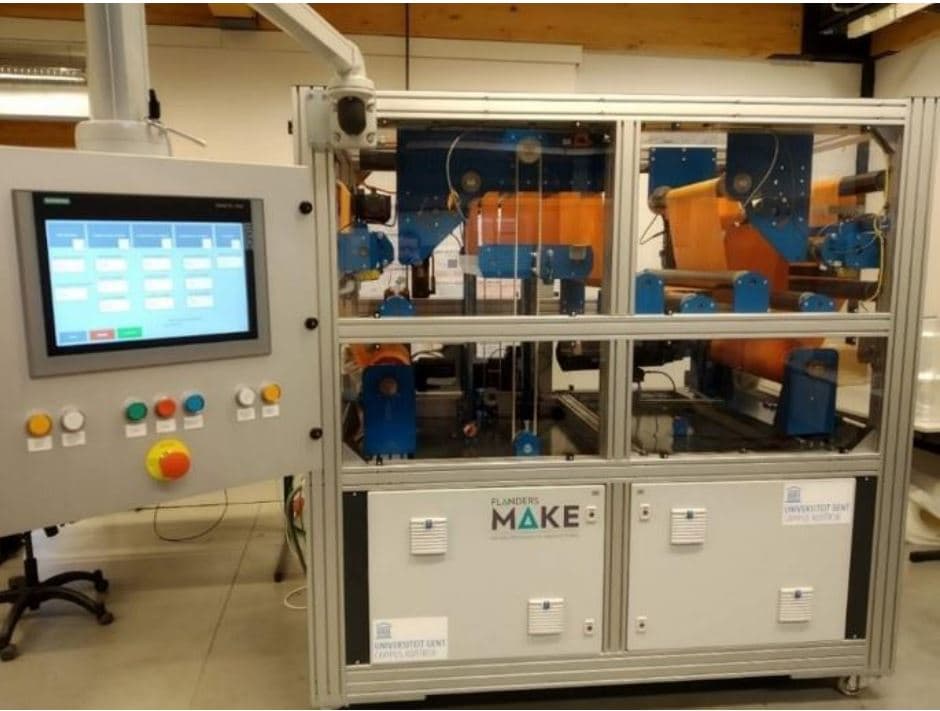
The material in the winding material is uncertain and needs to be identified from data and physics-based models, but also by applying proper excitation control signals. We developed a hybrid model to identify the characteristics of the material that is not possible to find when using only physics or data. Further, a linear process (writing on the paper) has been added and the quality of the process was predicted based upon a NN model whereby the model includes machine setting inputs. This allows to adopt the machine settings in view of the targeted quality.
Publication
A. Mathivanan, J. De Viaene, Y. Thielemans, J. De Kooning, and K. Stockman, “Non-linear friction characterisation of the unwinding group in a web processing machine,” in 2023 IEEE/ASME International Conference on Advanced Intelligent Mechatronics (AIM), Seattle, United states, 2023, pp. 1260–1265. http://doi.org/10.1109/aim46323.2023.10196290
Predicting slip in the machine
Increasing the speed of the production machine will in the end result in slip and low quality. Hence, in view of control, slip prediction is a key feature. A linear and a CatBoost model were trained and evaluated on low- and high-speed data. Feature selection (via forward selection and feature importances) showed that short time windows are most predictive. A union of selected features was used for fair comparison. For the linear model, sample weights emphasized high-slip regions to improve accuracy there. Results showed linear models perform slightly better at high speed, while CatBoost excels at low slip. An ensemble—CatBoost for low slip and linear for high slip, with a threshold based on traction roll quantiles—provides the most effective slip prediction.
Publication / paper in preparation
Paper "Predicting slip in web winding machine" under construction
Outputs & Resources
Publications
Mathivanan, J. De Viaene, Y. Thielemans, J. De Kooning, and K. Stockman, “Non-linear friction characterisation of the unwinding group in a web processing machine,” in 2023 IEEE/ASME International Conference on Advanced Intelligent Mechatronics (AIM), Seattle, United States, 2023, pp. 1260–1265. http://doi.org/10.1109/aim46323.2023.10196290
“Predicting slip in web winding machine” — under construction.
Models / Methods
Hybrid model for material characterisation.
Neural-network model for process quality prediction based on machine settings.
Slip prediction models using linear, CatBoost and ensemble approaches.