
Intensive Care Units
Use Case Description
In the intensive care unit (ICU), various types of multi-modal and time-dynamic patient data are being collected. This includes, e.g., patient history (static feature set), time series of (often) large numbers of structured (categorical or continuous) features (parameter measurements, lab results, specific interventions,...), medical images (CTs (consecutive), MRIs), clinical expert knowledge (symbolic or sub-symbolic) or daily textual descriptions of the patient status (by clinicians).
As such, there is a growing need for insights that can be derived over different conditions of admitted patients. The AI technology to gain such insights should be sufficiently generic. Furthermore, building clinically useful prediction models integrating multi-modal temporal data & expert knowledge is a fundamental challenge.
The solutions that will be devised in this use-case will be evaluated on two conditions with a high clinical importance:
• Getting insights in the incidence and predictors of vasospasms.
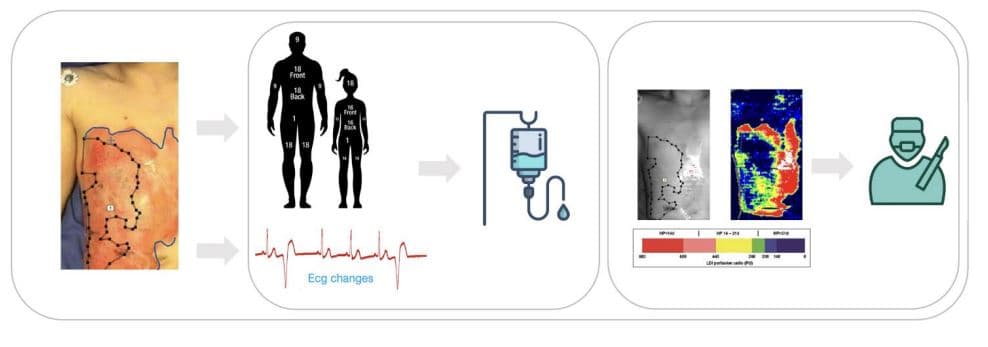
• Correct identification of initial burn depth for optimal treatment and referrals.
Condition 1: Vasospasms
Subarachnoid hemorrhage is a stroke that is caused by bleeding in the space between the brain and the surrounding membrane, and typically affects patients age 50, causing an important socio-economic impact. In the first 3 weeks after the bleeding, the brain blood vessels may narrow (vasospasm) which may substantially limit blood flow, causing irreversible brain damage.
The incidence and predictors of vasospasm are nowadays not yet fully understood.
Which patients are at a higher risk of having vasospasms or death?
What causes vasospasms to be persistent in certain patients, leading to increased mortality?
What is the relation between vasospasms and heart failure?
Is vasospasm detectable by plain electrocardiography (ECG)?
The goal is to develop advanced machine learning techniques on available data sets to get insights, and to avoid lasting neurological consequences for affected patients and to reduce mortality.
Condition 2: Burn depth
Burns are the fourth most common type of trauma worldwide, and have a considerable health-economic impact due to the prolonged hospitalization and rehabilitation periods, combined with costly wound and scar treatment. The identification of initial burn depth is currently based upon clinical assessment, but the accuracy is only 50-80%. Correct identification of initial burn depth is crucial for optimal initial treatment and referral decision to specialized center.
Which patients require referral to a Burn Unit?
Which patients need immediate resuscitation fluid therapy (related to extensive and deep burns)?
Is degree of burn reflected in ECG pattern? (~ relation with burn shock)
Is advanced interpretation of definitive burn depth evaluation by laser Doppler imaging (LDI) possible?
Which patients need surgery?
Which burned skin zones need surgery?
The goal is to develop advanced machine learning techniques on available data sets to get insights to avoid unnecessary referral to burn centers to start immediate correct treatment.
Results, Highlights & Research Outputs
ECGEncode: Compact and computationally efficient deep learning feature encoder for ECG signals [J1]
The visual interpretation of electrocardiogram (ECG) data is driven by human pattern recognition and requires in-depth medical knowledge. Although state-of-the-art deep learning models can automate and improve ECG feature extraction and analysis, they face deployment challenges, particularly on medical edge devices, due to their extensive computational demands and large parameter counts. To address these limitations, this work introduces ECGencode, a novel deep learning feature encoder optimised for ECG data. ECGencode is characterised by its intuitive, compact, and expert-inspired architecture, drawing from the Filter Bank Common Spatial Patterns method traditionally used in EEG signal analysis. It leverages depthwise and separable convolutions to provide state-of-the-art analysis performance at a fraction of the computational cost. Designed for intuitive model configuration and providing a latent space that retains the structure of an ECG, ECGencode can be incorporated into a wide variety of ECG analysis models. Furthermore, a novel spatial Gaussian noise regularisation technique is introduced, promoting the learning of more generalisable features. ECGencode stands out for its reduced computational requirements, using only 3.79% of the trainable parameters and 12.39% of the FLOPs compared to the benchmark model for normal sinus rhythm atrial fibrillation detection and new-onset prediction. Furthermore, an LSTM-extended ECGencode model matches the performance of leading multi-label classification models with a tenfold reduction in parameters. These attributes position ECGencode as a highly efficient tool for ECG analysis, with the potential to facilitate its adaptation in resource constrained cardiac diagnostics and monitoring settings.
Augmentation-Free Longitudinal Modeling through Structuring Whitened Embeddings [J2]
Structuring Whitened Embeddings , a modality- and encoder-agnostic framework designed to optimize encoders for extracting smooth, progression-aware feature representations by aligning real-world samples is introduced. Proportional inter-sample relationships are preserved, enabling the capture of subtle and continuous changes. By establishing relationships directly between samples and thereby avoiding the need for data augmentation, the approach is particularly well suited for transformation-sensitive data, such as medical time series, where even minor sample changes can lead to disproportionate shifts in interpretation. Experimental results on early atrial fibrillation prediction and timestamp imputation, modeling both inter- and intra-patient dynamics, demonstrate significant performance improvements using the optimized features. The framework's augmentation-free design and generalizability across tasks and modalities position it as a practical solution for modeling evolution in complex datasets.
Causalteshap: discerning predictive from prognostic features for treatment effect analysis [J3]
Treatment effect analysis investigates the effect of a treatment or intervention. The variables that will determine the treatment effect are called, predictive variables, while prognostic variables determine the outcome regardless of treatment, based on existing conditions on characteristics. The identification of these predictive factors facilitates understanding the treatment effect and even allows for improving its success. However, in many cases, the predictive factors of a treatment or intervention are unknown. Furthermore, methods to find these predictive factors are limited and only focus on quantifying the predictive performance of a CATE estimator instead of discerning predictive from prognostic variables. Therefore, to find these predictive variables we present Causalteshap. Causalteshap is a Shapley-based method that leverages multiple statistical tests and treatment effect estimators to discern prognostic from predictive features. The method is benchmarked on multiple fully synthetic datasets and four semi-synthetic datasets. In most of these benchmarks, Causalteshap demonstrates high precision and recall performances above 0.9. Subsequently, Causalteshap is applied to a real-world ICU use case using the AmsterdamUMCdb dataset. We analyzed the effect of Noradrenaline on Atrial Fibrillation in the ICU to display the potential of Causalteshap as a tool for treatment effect analysis. Our results demonstrate that Causalteshap has the potential of combining treatment effect estimators with Shapley values and statistical tests to provide a novel method for discerning predictive from prognostic features in treatment effect analysis and making understanding treatment effects more accessible.
CSD-AFNet: Efficient Atrial Fibrillation Classification from ECGs using 2D Causal Strided Dilated Convolutions [C1]
Automated analysis of electrocardiogram (ECG) signals using deep learning (DL) methods has shown substantial promise in atrial fibrillation (AFib) classification, particularly for detecting subtle indicators during normal sinus rhythm and for predicting new-onset AFib. However, many existing state-of-the-art models exhibit high computational demands, characterized by large parameter and floating-point operations (FLOPs) counts. This presents a high barrier to entry for training in budget-limited institutes and hinders the models’ deployment on medical edge devices. This paper introduces CSD-AFNet, a computationally efficient DL model specifically designed for AFib-related ECG classification tasks. CSD-AFNet achieves substantial reductions in both parameter and FLOPs counts by replacing expensive temporal convolutions with novel Feature-Preserving Pooled Convolutions (FPP-Convs). FPP-Convs enable the combination of striding and dilation without input feature loss, preserving temporal coverage while reducing the computational cost. The model further incorporates two-dimensional causal padding to prevent temporal leakage in downstream representations. Evaluation on the public CODE-15% and PTB-XL datasets demonstrates that CSD-AFNet matches the classification performance of leading benchmark models while reducing parameter count by a factor of 71 and FLOPs by a factor of 122 compared to the ResNet10-inspired baseline. These findings support the suitability of CSD-AFNet for practical clinical scenarios, enabling training under resource constraints and efficient inference on medical edge devices, thereby facilitating scalable and cost-effective ECG-based AFib screening and monitoring.
Outputs & Resources
Journal publications
[J1] L. Bontinck, K. Fonteyn, T. Dhaene, D. Deschrijver, "ECGencode: Compact and Computationally Efficient Deep Learning Feature Encoder for ECG Signals", Expert Systems with Applications, Volume 255, Part C , 1 December 2024.
[J2] K. Fonteyn, L. Bontinck, T. Dhaene, D. Deschrijver, "Augmentation-Free Longitudinal Modeling through Structuring Whitened Embeddings", IEEE Access, in print, 2025.
[J3] J. Verhaeghe, F. Ongenae, S. Van Hoecke, "Causalteshap: Discerning Predictive from Prognostic Features for Treatment Effect Analysis", International Journal of Machine Learning and Cybernetics, 21 pages, 2025.
Conference publication
[C1] L. Bontinck, A. Steyaert, H. Chen, T. Dhaene, D. Deschrijver, "CSD-AFNet: Computationally Efficient Atrial Fibrillation Classification from ECGs using 2D Causal Strided Dilated Convolutions", IEEE Conference on Biomedical and Health Informatics (BHI 2025), Atlanta, GA (USA), 7 pages, October 2025.
PhD dissertations
[D1] J. Verhaeghe, "The Design of Predictive and Uncertainty-Calibrated Treatment Models for the Intensive Care Unit", Ghent University, 2025.
Team & Contact
Contact
Tom Dhaene, UGent - IDLab: tom.dhaene@ugent.be
Dirk Deschrijver, UGent - IDLab: dirk.deschrijver@ugent.be
Use Case Lead(s)
Tom Dhaene, UGent - IDLab
Principal Investigators / AI Expert Leads
Dirk Deschrijver, UGent - IDLab
Sofie Van Hoecke, UGent - IDLab
Femke Ongenae, UGent - IDLab
Celine Vens, KU Leuven - ITEC
PhD Researchers
Karel Fonteyn
Lennert Bontinck
Hongbing Chen
Niels Jodts
Jarne Verhaeghe
Research Groups
IDLab, UGent
GAIM, UGent
ITEC, KU Leuven